Dear Mr. Cobb: You are a very strange man, and quite possibly insane as well. Therefore, I like you. Sadly, you are also very wrong. And because me being right and you being wrong is somehow important in this strange little world we inhabit, please, allow me, then, to retort.
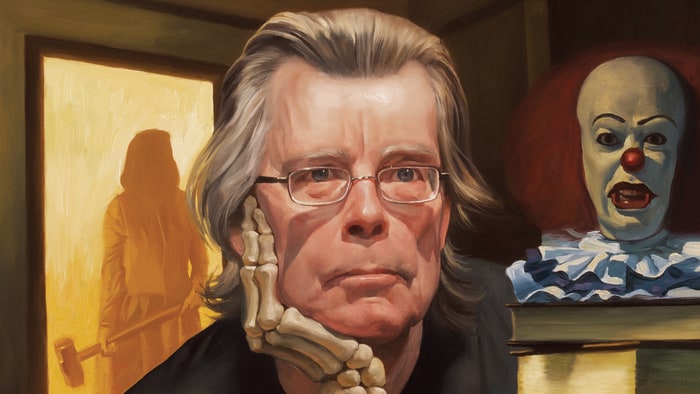
I hereby present to you: A Treatise on the Misapprehensions of one Bartholomew Cobb: Or, How Loudness Mistook Itself for Luminosity. In the annals of literary altercation, there occasionally emerges a spectacle so florid, so audaciously performative, that it dares one — with a mixture of bemusement, scholarly indignation, and tempered outrage — to lift one’s pince-nez, settle oneself upon a suitably creaking fauteuil, and engage in what may politely be termed the dissection of a rhetorical caricature. Such is the present case, wherein Mr. Bartholomew Cobb, hereafter to be referred, for reasons that will shortly crystallize, as Corny Cobb, has expended prodigious faculties of prose upon the condemnation of one Stephen King.
Permit me first, if you will, a brief foray into the meta-theatrics of Cobb’s composition. It is a work suffused with the grandiloquence of adolescent hyperbole, a cacophonous concatenation of exclamatory eruptions, theatrical gesticulations, and the sort of grotesque, almost operatic anecdotalism that might best be described as Gonzo Baroque. Yet despite its energetic incandescence, it is, at heart, a diorama of pathos without logos, a cathedral of vituperation whose spires reach towards the firmament but whose foundation lies upon the shifting sands of subjective indignation.
Cobb’s ostensible grievance, namely the dictum that “plotting is the first resort of bad writers,” has been lifted, as if by a perverse magnet, from the text of On Writing, and then deployed as though it were a grand imperial edict, rather than the playful provocation that it is. Here one must interject with utmost civility: an aphorism, like a finely tempered rapier, derives its utility not from brute force but from precision of deployment, its function contextual, its blade honed upon the marrow of nuanced discourse. To extract it wholesale from its epistemic and literary soil and fling it across the reader’s cerebellum with the force of a trebuchet is to commit a trespass both methodological and aesthetic.
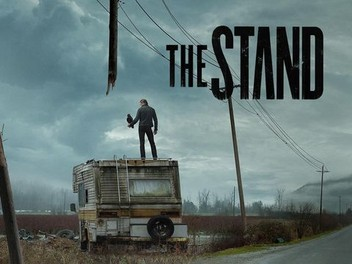
One may then observe, with a judicious blend of irony and gentle condescension, that Mr. Cobb’s reading of King is framed exclusively through the lens of idiosyncratic irritation. Long passages of The Stand — where King carefully orchestrates character interaction, mythic resonance, and temporal cadence — are construed, astonishingly, as egregious demonstrations of narrative sloth. The cataloging of minutiae — pamphlets, geographical coordinates, sartorial peculiarities — is interpreted as evidence of literary ineptitude, rather than the deliberate layering of the human and mythic fabric of the narrative. Here it is necessary to invoke, if somewhat anachronistically, the Aristotelian precept of mimesis: that art, in its highest form, must imitate not merely actions, but the complex interrelations, moral contortions, and existential predilections of sentient beings. Cobb’s critique, while floridly performed, tragically misconstrues King’s deliberate exercise of narrative patience as evidence of slovenly craft.
Furthermore, it is imperative to consider the philosophical dimensions that Cobb, perhaps unwittingly, brushes aside with cavalier disdain. If one accepts, following the metaphysical intuition of Sartre and the phenomenological hermeneutics of Heidegger, that human consciousness is constituted through temporality, social embeddedness, and the iterative revelation of being-in-the-world, then King’s approach — his deliberate, often labyrinthine accrual of minor detail — emerges not as indolence but as a literary analogue to the existential unfolding of reality itself. Cobb’s exclamatory outrages may amuse, but they are ontologically impotent: they address the superficial accretions of a narrative without apprehending the underlying existential scaffolding that gives the narrative coherence and ethical resonance.
Let us not neglect, in this regard, the ontological principle of character over plot, which Cobb derides with such flamboyant vehemence. Here, too, his argument collapses under scrutiny. The creation of character is, in King’s schema, inseparable from the teleology of plot; the two are dialectically interwoven. It is the interplay, the Hegelian synthesis of characteric determinism and plotic contingency, that generates the tension and catharsis the reader experiences. To perceive this as “corny” or merely laborious is to substitute surface agitation for analytic acumen. One might, indeed, propose a neologism: Cobb’s critique is epiphenomenal philistinism, the dislocation of outrage from the substantive critique that true literary exegesis demands.
Permit me, before concluding this rather prolix excursus, to offer the gentleman a pathway back into discourse of the genuinely philosophical and literarily rigorous variety. If he is prepared to exchange spectacle for examination, hyperbole for hermeneutics, and tantrum for textual analysis, I shall willingly engage him, line by line, paragraph by paragraph, in the earnest study of the narrative architectures, characterological intricacies, and mythopoeic structures that comprise King’s corpus. Until such a moment of methodological seriousness, however, his Halloween tirade remains precisely that: a seasonal performance, a chiaroscuro of emotion untempered by insight, and a remarkable testament to the human capacity for rhetorical pyrotechnics.

- Extended Philosophical Exegesis
To proceed, we must traverse from the mere surface of Cobb’s indignation into the vertiginous heights of literary ontology and epistemology. King’s texts operate not merely in the dimension of linear temporality, but across manifold narrative strata, wherein microcosmic human dilemmas instantiate macrocosmic mythic structures. Cobb, in his hyperbolic zeal, registers only the surface; he perceives the pedestrian metric of scene-count, page-length, and catalogued minutiae, entirely ignoring the subtle interplay between the human telos and mythic resonance.
Drawing loosely upon Platonic ontology, one might suggest that King’s characters are imperfect manifestations of the Form of Humanity, constrained by narrative circumstance but suffused with essential qualities — fear, hope, moral ambivalence — that resonate across the metaphysical spectrum. Cobb’s complaint that King “fails to show” is thus a misperception: King’s showing is enacted not through minimalist economy but via accumulative existential layering, a literary technique akin to the topographic stratification employed in archaeological hermeneutics. Each ostensibly trivial pamphlet, each geographically precise footnote, is a sedimentary deposit of narrative truth, awaiting the reader trained in patience and semiotic discernment to excavate.
If one invokes Kantian aesthetics, King’s oeuvre exemplifies what might be termed the sublime in horror: the reader confronted with the enormity of human frailty, moral contingency, and cosmic indifference, yet compelled toward a moral apprehension that transcends mere terror. Cobb, by contrast, experiences horror only at the perceived inefficiency of the narrative apparatus, missing entirely the teleological and ethical currents that animate King’s work. One must wonder: can a critic truly apprehend the sublime if his faculties are enslaved to superficial exasperation?
The semiotics of place names, pamphlets, and accoutrements — the very elements Cobb decries — are, upon closer inspection, instruments of diegetic fidelity. By meticulously mapping these extrinsic elements, King constructs an ontologically consistent universe, wherein the mundane and the mythic coexist in dialectical tension. Cobb interprets these markers as mere padding; I suggest they are a lattice, a Cartesian scaffold for the soul of the narrative, linking human cognition to the sprawling architecture of the imagined world.
Furthermore, King’s treatment of temporality — with events recapitulated across decades, parallel timelines, and characters whose moral and psychological development accumulates like sediment — is nothing less than a meditation on the phenomenology of narrative time. Cobb’s insistence that repetition constitutes incompetence fails to apprehend that such repetitions mirror the iterative nature of lived experience, the recurrence of trauma, memory, and ethical reckoning. To disregard this is to substitute superficial affective response for critical insight — a temptation most entertaining, but ultimately impoverishing for the would-be critic.

- A Gentle Conclusion (With Corny Cobb’s Baptism)
Thus, with spectacles perched, quill trembling slightly under the weight of erudition, I bestow upon Mr. Bartholomew Cobb the sobriquet he has demonstrably earned: Corny Cobb. This is neither cruelty nor caprice, but a nominative courtesy grounded in observation: his prose is corny, flamboyant, excessively performative, yet unmoored from the rigorous scaffolding of philosophical or literary method. It is a parade of rhetorical fireworks, delightful to witness, but devoid of the constructive critique necessary for genuine literary discourse.
So, dear Mr. Corny Cobb, to conclude: if you wish to elevate your practice from the merely performative to the philosophically informed, I entreat you: bring your analysis back to the text. Engage not only with emotion and spectacle, but with ontology, semiotics, narrative philosophy, and the subtle interplay of human telos within fictional architectures.
I salute you, sir.


Leave a Reply