There are a few moments in one’s longstanding movie-watching career that stand out, do they not? Movies that made such an impact that, even though you haven’t seen them in years, you still remember them clearly. Sometimes it’s because they were big movies making a big impact, but sometimes, just sometimes, it’s the small, quiet movies that have the biggest effect, not because they stomp and shout, but because they are modest. I do hope you recognize this, dear reader. These are the sort of movies you cherish. You hold dear.
So, please allow me, then, to share this one with you. The Red Turtle is a 2016 animated movie by Michael Dudok de Wit. Its runtime is one hour and twenty minutes, and in all that time not a single word of dialogue is spoken. The music plays the role of narrator, and it does so in the same way as the movie itself: quiet, whispering, meditating. Flowy. This movie is captivating. Yeah, that’s the right word, I think. It grabs you, not by the throat, like some movies, but by your arm, gently, friendly, and guides you into its world… Its beautiful, mellow, pale-colored world…
Here, we meet a man. He wakes up on the beach, sand wet, hair stuck to his forehead, and for a long moment he just breathes, listening to the sea speaking in waves, whispering secrets he almost understands. Tiny crabs scuttle past his toes, busy in their own quiet world, carrying on with the patience of beings who know nothing of storms or regrets. The island stretches around him — pale sand, bamboo forests that sway like gentle green flames, a smooth rock hill standing sentinel, quiet and immovable. And he is small, suddenly aware of every inch of himself against the slow, patient world.
Water, fruit, shelter — it is all here, offered without words. He tries to leave. Bamboo sticks become a raft. He sets it afloat, heart full of hope. But the sea is patient, too, and the unseen force that waits beneath the waves pulls him back, again and again. A creature, silent, immense — a giant red hawksbill turtle. He does not see it at first, only feels its presence, an invisible hand reminding him that he belongs nowhere and everywhere at once.
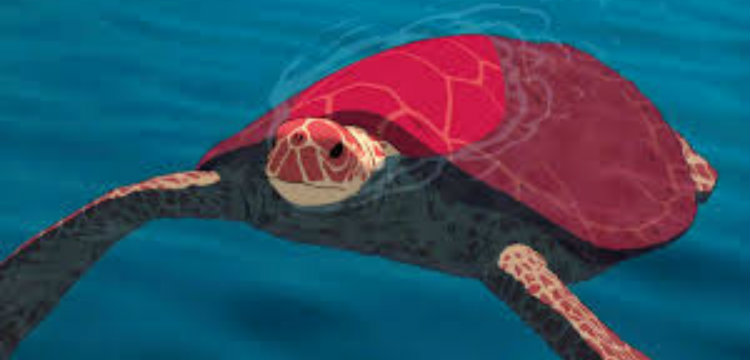
Anger rises one evening, sharp and brief. He strikes the turtle with a bamboo stick, flips it, strands it, and the weight of his own action settles heavily in his chest. When he returns to care for it, the turtle is dead, and in its place, a woman — red-haired, sleeping inside a broken shell. He fetches water, builds her shelter, waits. When the rain hits, she wakes, moves through water like a memory made flesh. There are no words, ever, and yet they begin to understand each other — a language older than speech, carried in gestures, glances, shared breaths.
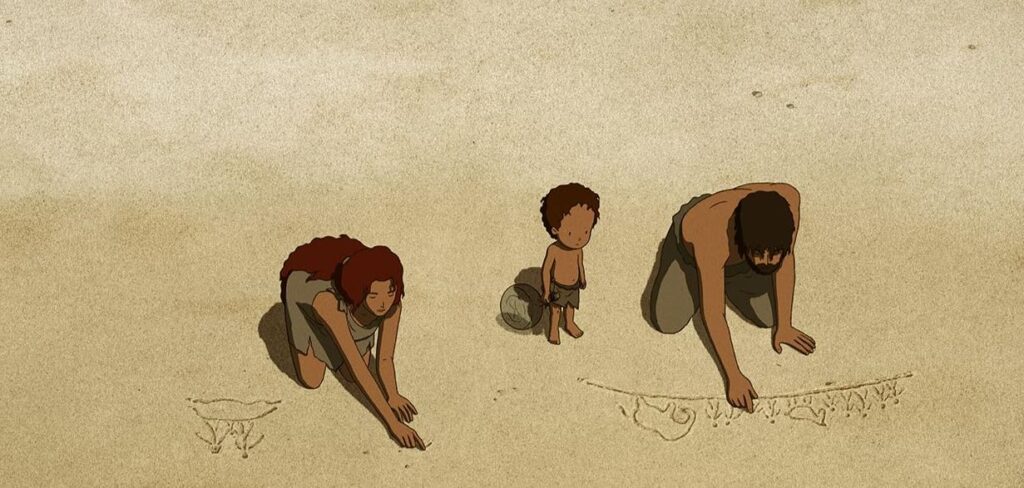
Time passes softly. Days stretch and fold into one another. The couple learns the rhythm of the island — food, storms, the rise and fall of the sun, the music of life without words. They fall in love. A son is born. Curious, eager, he finds a glass bottle and listens to pictographs tracing their story. He learns to swim, to move through water as if it had remembered him, as if every turtle, every wave, had been waiting.
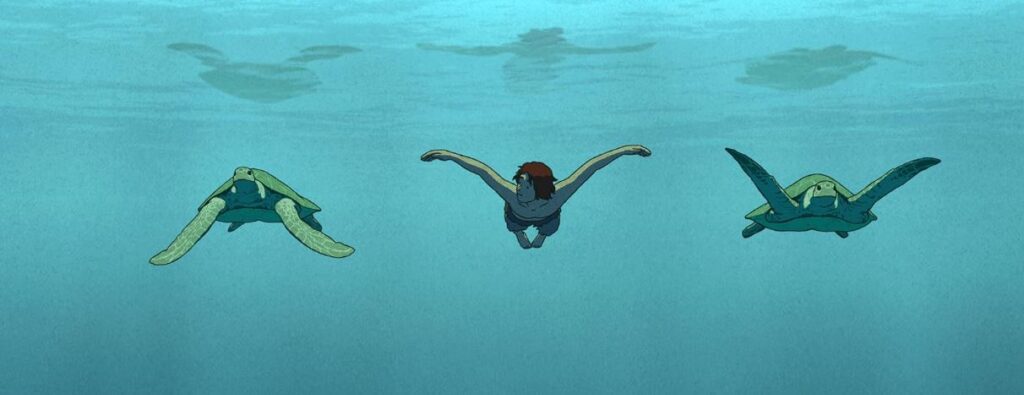
Years move gently, until a tsunami hits, tearing bamboo forests, scattering family. The sea is cruel and patient both. The young man swims, discovers his mother, finds his father clinging to bamboo, and together, with green turtles guiding him, rescues him. They rebuild in silence, tending the wreckage, burning what is lost, learning patience and resilience from the island itself.
And later, the young man dreams of the ocean beyond, static and infinite, and decides it is his calling to swim into it, guided by instinct and curiosity. The parents remain, aging together, watching the sun and the tides, living lives shaped by quiet wonder. And at last, when the man closes his eyes forever, the woman grieves, lays beside him on the beach and lays her hand upon his… and then transforms, returning to the red turtle, the cycle completing, the whisper of life continuing, endless and calm, like waves brushing softly over pale sand.
This movie is… something that isn’t easy to name. It isn’t a story in the usual sense, not really, not with dialogue or speeches or explanations. It is the feeling of being there, on the pale sand, watching waves fold over themselves, seeing the red turtle move with patient inevitability, the couple learning, the boy growing, the island breathing along with them. It is about survival, yes, but not the kind that shouts or thrills — survival as meditation, as gentle attention to each moment, to each small gesture that matters. Watching it, you feel time slow.
And it is achingly beautiful. The colors, the light, the textures of the bamboo, the rock, the water — everything seems to be alive, somehow, shimmering slightly, like a memory remembered twice. The music drifts and flows, sometimes near, sometimes distant, carrying emotion without word. You are drawn in, hypnotized, as if the film itself were guiding your gaze, your thoughts. And in the quiet between one frame and the next, you feel the ache and the wonder, the simplicity and the depth, the sorrow and the joy — all at once, soft, unspoken, and utterly unforgettable.
Made by , like I mentioned, Dutch animator Michael Dudok de Wit (who also made the hauntingly beautiful and Oscar-winning short film Father and Daughter) and co-written with French screenwriter Pascale Ferran.
Captivating. Beautiful…and Quiet.
Leave a Reply