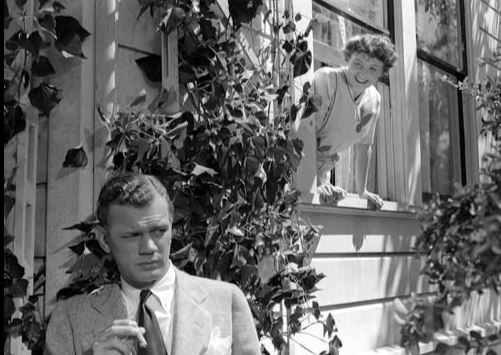
“What’s the use of looking back? What’s the use of looking ahead? Today’s the thing. That’s my philosophy.”
Edgar Allen Poe coined the term “imp of the perverse” in 1845 to describe that irrational, irresistible urge toward self-destruction, and like so many of Poe’s characters, Charlie Oakley (Joseph Cotten) in Alfred Hitchcock’s Shadow of a Doubt fails again and again to resist it. From the moment we are introduced to him in New York, lying in bed with a cigar, cash carelessly strewn about, we get the sense that this is a man who no longer cares about his own fate. Perhaps he never did, at least since the accident later described by his sister, Emma (Patricia Collinge), which may have been the beginning of Charlie’s murderous sociopathy. “He fractured his skull,” she says, “and then it was like he had to get into mischief to blow off steam. He didn’t do much reading after that.”
“I may go out to meet them,” Charlie says of the detectives pursuing him. “Then again, I may not… not yet.” Teetering so precariously close to the edge, he instead resolves to continue evading capture, taking a train across the country to Emma’s home in Santa Rosa. “Santa Rosa, California,” he repeats at the end of the telegram in which he announces his plans, thereby establishing the idyllic small city in which the rest of the film will take place. Thornton Wilder was enlisted to flesh out the story and characters because Hitchcock so admired Our Town, and it is this sensibility mixed with the good old Hitchcockian darkness that makes Shadow so endlessly compelling. Charlie’s retreat to these environs may seem, even to him, like a logical way to continue evading the law, but it is ultimately the path to his own downfall, albeit at the hands of a more worthy adversary.

Charlotte “Charlie” Newton (Teresa Wright) adores her Uncle Charlie, sharing not only a nickname but a mysterious psychic bond with him. As he lies on his hotel bed in NYC contemplating suicide, she too lies despondent in Santa Rosa, complaining to her father, Joe (Henry Travers), of her disillusionment with their average family life: “We just sort of go along and nothing happens. We’re in a terrible rut.” Fed up with existence, just like her uncle, she realizes he might be “just the one to save us” at the same time he comes to the similar conclusion that a visit to Santa Rosa might be just the thing to save himself.
The thick black cloud emitted by his train pulling into the station signals the arrival of Evil in sunny Santa Rosa. Twice in these early scenes Charlie is described as “sick” by people who don’t know how right they are. First Joe hears of the telegram his bookish youngest daughter Ann (Edna May Wanacott) didn’t take down because she couldn’t find a pencil (“I looked”) and assumes “someone must be sick.” Then the younger Charlie sees her uncle stepping off the train as a haggard old man with a limp before he pulls a Wonka and reveals the spry devil she (thinks she) knows and loves. “At first I didn’t know you,” she says as they embrace. “I thought you were sick.” “Sick?” he replies. “Me, sick?” Perish the thought! Not a thing wrong with him as he lights a cigar and watches his family scramble to carry all his luggage for him. “It’s nothing,” Little Charlie enthuses. “I love to carry!”
“I don’t believe in inviting trouble,” Joe says when he admonishes Charlie not to throw his hat on the bed. Charlie does, though; he’s spent most of his life inviting trouble, as he does when he makes a big show of himself at Joe’s bank, depositing a remarkable sum of money for a man who’s meant to be laying low. $40,000 (in 1943 dollars, no less) is a joke to him, like the whole world. His niece waxes rhapsodic about “something secret and wonderful” deep inside him, something no one knows about. “It’s not good to find out too much,” he warns her, disturbed by the thought of her learning his darkest secrets, so of course he insists on giving her a ring from one of his victims.

Not much of a plan for a man who truly wants to evade paying for his crimes, hiding out with his only relatives and assuming he can outsmart them all. It’s not just Little Charlie; the whole family is full of smart cookies, such as bookworm Ann and little Roger (Charles Bates) with his head for numbers and distrust of superstition and the government. Meanwhile, Joe and his best friend, Herb (Hume Cronyn), are almost amateur detectives with their constant discussions of how to commit the perfect murder (“We’re not talking about killing people; Herb’s talking about killing me and I’m talking about killing him”). Poor Emma is the closest to Charlie, other than her daughter, but she is too blinded by her love for him to ever pry under the surface (“He’s just in business, you know, the way men are”).
“Details are most important to me,” Charlie says with a faraway look, as Little Charlie sits right beside him. After gifting her the ill-gotten ring and making a big show out of stealing the page in the newspaper about his murders, it’s as if he’s imploring her to investigate him and uncover the truth. He wants her to be the one to unmask and destroy him, not those corny dicks who’ve been following him. The item in the newspaper would likely have gone unnoticed by the family at large, and certainly wouldn’t have cast any suspicion on him, but like one of Poe’s antiheroes he is compelled to point out the beating of the heart beneath the floorboards.
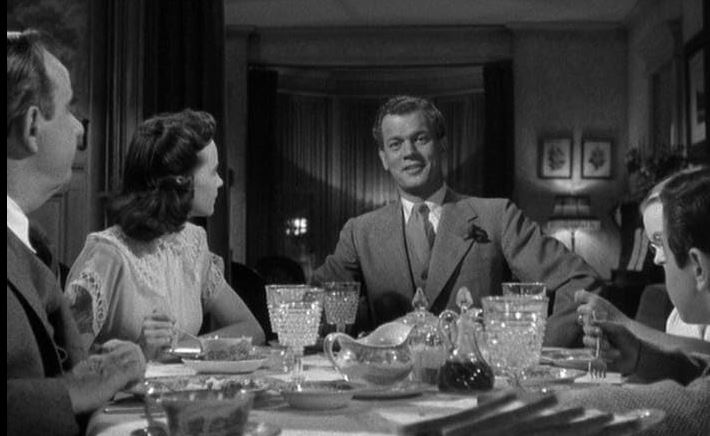
“The cities are full of women,” Charlie says one night at dinner, letting the mask of civility and empathy slip. “Middle-aged widows, husbands dead, husbands who’ve spent their lives making fortunes, working and working, and then they die and leave their money to their wives, their silly wives. And what do the wives do, these useless women? You see them in the hotels, the best hotels, every day by the thousands, drinking the money, eating the money, losing the money at bridge, playing all day and all night, smelling of money, proud of their jewelry but of nothing else. Horrible, faded, fat, greedy women.”
“They’re alive,” Little Charlie cries out in horror. “They’re human beings!” “Are they?” her uncle replies with a cold glare. “Are they human, or are they fat, wheezing animals? And what happens to animals when they get too fat and too old?” He might as well have an I MURDER WIDOWS sign on his forehead, but even old murder mystery-loving Joe is all but oblivious to the darkness. Only Little Charlie sees the truth, which her uncle already suspects, once again tossing his hat on the bed with this brutal speech. He tears the mask all the way off when they’re alone later at a sleazy dive bar in which no one would ever expect to see Little Charlie. “Do you know the world is a foul sty?” he berates her. “Did you know if you ripped the fronts off houses you’d find swine? The world is a hell; what does it matter what happens in it?”
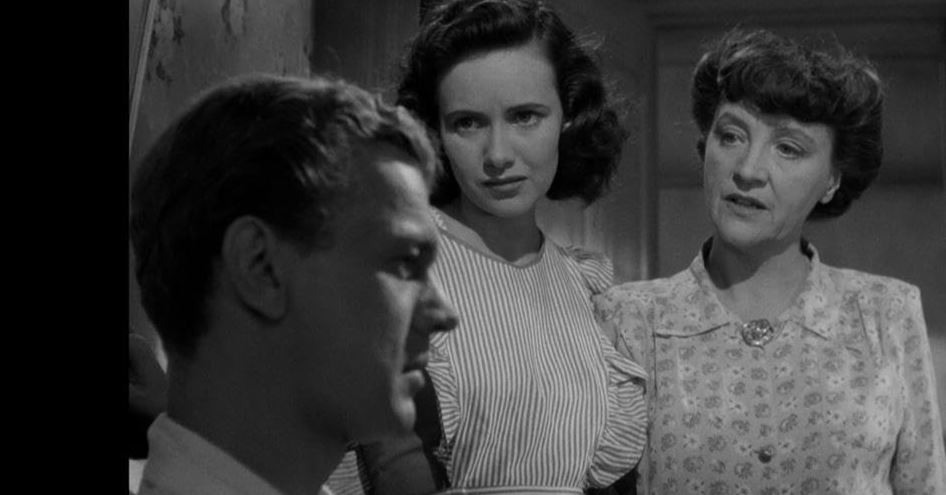
Both Charlies know how much the truth would just destroy Emma (Collinge is heartbreaking and wonderful in this role) and, of course, Uncle Charlie exploits this knowledge to make Little Charlie help him get away with it. When the “other fella” pursued in connection with the murders meets a grisly demise, Uncle Charlie is momentarily exuberant at being exonerated, but then there’s Little Charlie at his back, iconically framed in the light of the doorway. She is the good left in him, his conscience, and while she lives he can never be free. It is in this moment that he resolves to murder this part of himself and embrace the darkness, which leads to his demise.
In its final moments, Shadow’s theme of darkness hidden beneath a perfect surface is laid bare in the juxtaposition of Uncle Charlie’s eulogy (“The beauty of their souls, the sweetness of their character, live on with us forever”) with Little Charlie’s lament for the dark side of his soul: “He thought the world was a horrible place. He couldn’t have been very happy, ever.” Hitchcock stated several times throughout his life that Shadow of a Doubt was his finest film, and I tend to agree with him. Full of expertly written characters, crackerjack dialogue, and brilliant performances, it is top-tier film noir, as well as one of the best serial killer movies, from a time long before that term was commonly used.
Leave a Reply