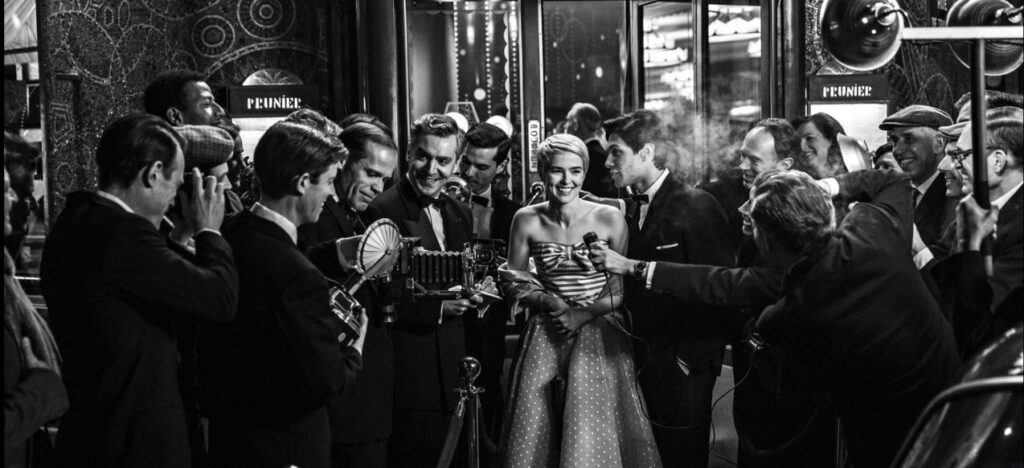
Richard Linklater’s Nouvelle Vague is something of a miracle. Not because it’s the greatest movie ever made, mind you, nor the grandest pronouncement of the cinematic season, but simply that it exists at all. For here, in 2025, if anything is not being called for, it’s a docudrama chronicling the soup to nuts construction of the French New Wave’s most influential offering, 1960’s Breathless. That Jean-Luc Godard’s seat-of-your-pants middle finger to traditional filmmaking is considered an undisputed masterpiece is almost beside the point. It’s enough that it was conceived and released into a world that was bursting at the seams with bloated musicals and heartless epics that sought little else except to offer an alternative to television. Godard, here and in the real world that nurtured him, remains a certified titan of the art form, yes, but also one of its most indelible pricks. We hate like hell that we need him, but need him, we do. Linklater finally explains why.
At first it might appear that Nouvelle Vague is but an obvious stunt, using the style, stock, and ironic detachment of the period to traffic in cheap nostalgia, but once things really get going, you realize there’s no other way to tell the tale. Dozens of the period’s brightest lights are on hand (Melville, Truffaut, Rohmer, among others), but rather than identify them through traditional means, they sit, composed, staring straight at us, with their moniker written below. It’s artificial, yes, but a good deal better than having someone whisper, “Hey, isn’t that Agnes Varda?” as she enters the room. We’d have figured that Linklater would know better. He also nailed the casting, preferring low key doppelgangers to big names that would stretch credibility. Lesser men might have given us George Clooney as Godard, but we get Guillaume Marbeck instead. Yeah, me neither, but I’ll be damned if he’s not absolutely perfect. The relative anonymity allows us to become immersed. Which we are, from frame one.
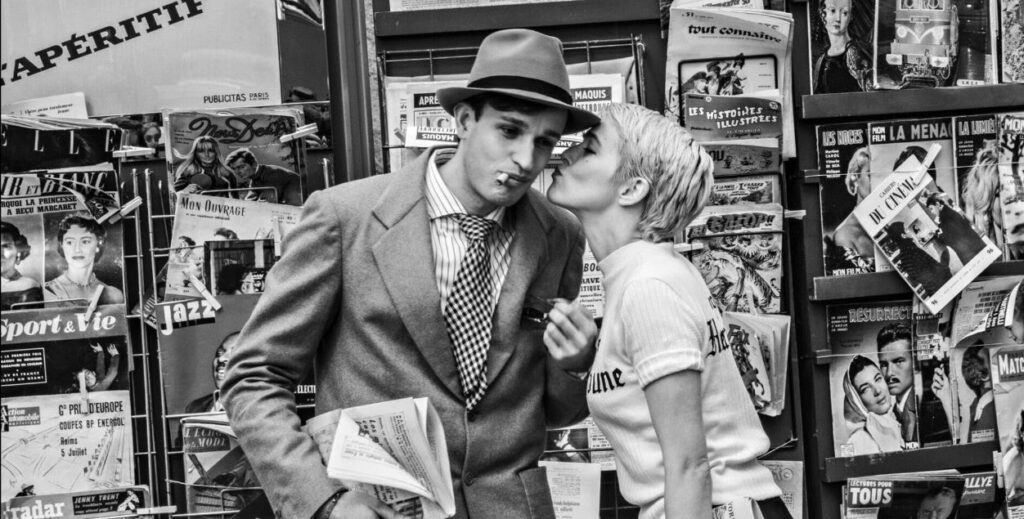
Who knows how accurate any of this is, and frankly, who the hell cares. Cinema isn’t a humorless historical record, and all that’s needed is the effort to have it feel right. Yes, we can imagine that Godard, a critic for the Cahiers du cinema, so believed that the best criticism of all was to make a film of one’s own that he’d channel his jealousy of rival Frenchmen into something that broke all the rules. Sure, it looks like laziness in lieu of preparation and talent, but you have to trust him. Easier said than done, I suppose, when the money isn’t yours, but if Godard believed anything, it’s that acting as if you can is well over half the battle. A script on the fly, guerrilla shooting in the streets (sans permits), and ad hoc locations; all part of the vision, which will certainly come together in the editing room. Or not. No one really knows, but the improvisational madness of it all is truly a break from studio-imposed tradition. Much of what followed Breathless was forgettable junk, but there had to be a first. The groundbreakers, at minimum, deserve our respect.
I’m a sucker for anything that shows process, from Ed Wood to The Disaster Artist, so again, fuck the haters who might suggest that all we’re getting is yet another creation myth. Godard is an asshole, Truffaut dutifully suave, and the streets of Paris so impossibly lovely that you could film a nap-a-thon and achieve fine art. All are marked off in turn, and we never question the official story. This is how it was, we nod in agreement, as if the film itself were lost footage from some Marseille attic, only recently dusted off for our inspection. Still, maybe there is a revisionist agenda afoot when it comes to Jean Seberg (Zoey Deutch). We know of her troubles and early demise, but as played by Ms. Deutch, she’s so sweetly huggable that we long to see her again. And again. And yes, even wonder why she wasn’t the biggest star on the planet to rival Elizabeth Taylor. Here, preserved in amber, she’s shaking off the stench of Saint Joan to stand forever as the ingénue of our times. In reality, she did 34 films before dying at 40, but she need only have done one. This one. Linklater knows that more than anyone.
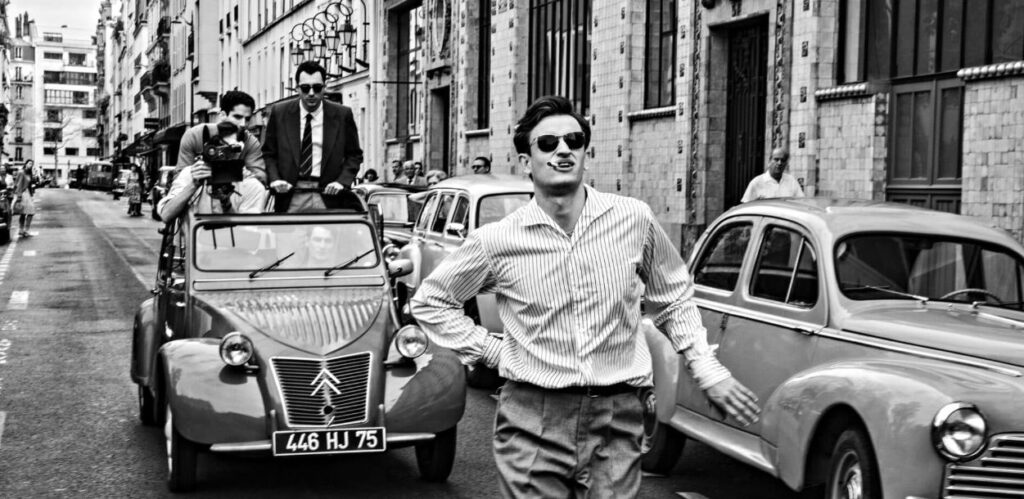
Back to Godard for a moment. If anyone lived his life in opposition, it was him, and there’s a certain beauty in portraying him as an aphorism-obsessed lunatic who chafed at tidying up a bedroom because it ruined the aesthetic. Life is far from linear (isn’t every waking moment a dizzying jump cut?), which speaks to the only quote that matters in such a context: “A story should have a beginning, middle, and an end, but not necessarily in that order.” Pretentious twat, sure, but fuck if he didn’t nail it. He goes on. “All you need to make a movie is a girl and a gun.” These days, not even that. “Cinema is the most beautiful fraud in the world.” Preach, JL. He spits these out as instinctively as breathing.
I could go on, as could Godard, whose interactions with his fellow humans seem little more than mind games disguised as affection, but in these moments, running about with chaotic randomness, a fierce order is revealed. Just as I used to hate abstract art because its meaning eluded me, I now realize that the worst of everything is understood the first time. Movies, paintings, people. So yes, push, challenge, break a few plates along the way. Breathless broke ‘em all. And Linklater, God bless him, resurrects the very reason why we should care. Today, more than ever. Hell, you don’t even have to like Breathless. Depending on the weather, I’m far from a big fan myself. But around the end of the Eisenhower years, a nutty Frenchman had an inkling. That became an obsession. And soon, a movement. Not all movements are alike, of course, or worthy of replication. But when they alter our world and force us to see it anew, it means something. Hopefully it always will.
Leave a Reply