
Everything moves in waves it seems. And I don’t necessarily mean that in some new-agey kind of way. Just look at weather patterns, economics, sunspots, even the tides themselves—most everything moves in waves. Movies, being the product of the society that created them, may also move along with the changes that society goes through, often also in big, sweeping waves. The idealized cotton candy world of the 50’s, breaks free from that in the 60’s, followed by the bleak reality check of the 70’s, and then once again rise up in a glorious haze of yuppies, coke, and Miami Vice… of the 80s! Do you see the waves there? Up and down it goes…
It is at the very beginning of this crest, in that ideal world of postwar prosperity and three-piece suits everywhere, and the ultimate faux-politeness, that we find Roger Thornhill. He is an advertising executive in New York. He’s wealthy and sheltered, having spent his life cocooned in comfort and privilege. Polished but naïve, and accustomed to a world that bends around him, he is a bit pompous, childish, and… not exactly quick on the uptake. So, when he is mistaken for a spy, he reacts accordingly as he mumbles, fumbles, and stumbles his way through it all, like a big child that isn’t quite sure what to do now that his mommy is not around.
Now, let me give you a quick summary of the story: Mr. Thornhill (Cary Grant) is mistaken for a secret agent and dragged into a dangerous espionage plot. After surviving a kidnapping and a series of deadly misunderstandings, he flees across the country, pursued by a mysterious gang and entangled with the enigmatic Eve Kendall (Eva Marie Saint), who has her own hidden agenda. From a deadly crop-duster attack in a cornfield to confrontations at art auctions and clandestine meetings, Thornhill gradually discovers that the agent he was mistaken for, George Kaplan, does not exist, while real spies manipulate events around him. The pursuit culminates in a tense showdown atop Mount Rushmore, where Thornhill races to save Kendall, thwart the villains, and survive a world that has suddenly proven far more dangerous than his privileged life ever prepared him for.
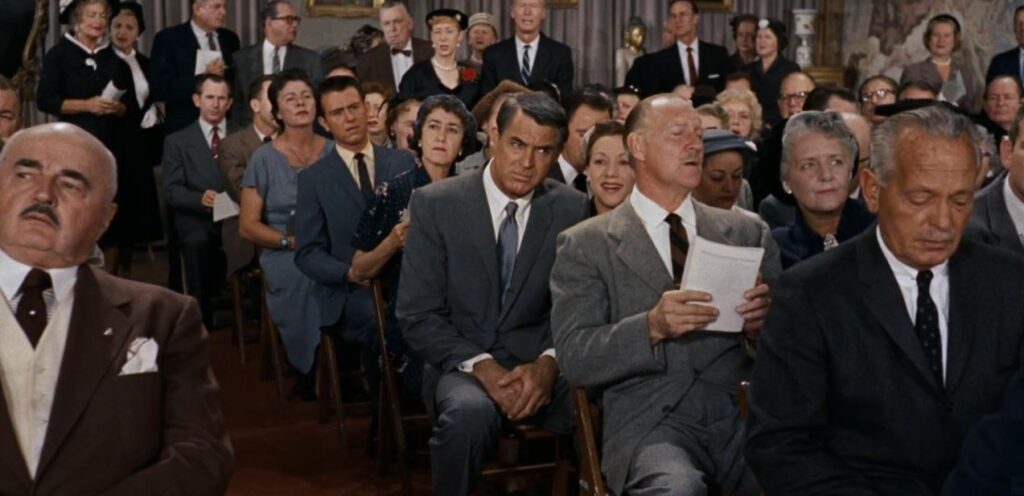
I saw this movie several times, and what stuck with me most is the way Mr. Thornhill reacts to just about everything that happens to him. If I tried to put it in writing, it might look something like this: ‘Uh… huh? What? Oh… So, this just happened? Okay, uh… Well, maybe I do… this? No… uh… what? Okay… No, I… wait… this is not…’ Dazed and confused—utter, British-like politeness in the face of disruption and disorder. And madness ensues…
Now, don’t get me wrong. I’m well aware of this movie’s reputation, out there in the real world, but to me, your average fledging movie reviewer, it’s not that much more than an entertaining, well-made spy thriller. I know how it’s generally regarded, a masterpiece, one of the best movies ever, and so forth. And if I were a ‘real’ film critic (if there is such a thing), I would now explain to you why this is the case with this movie.
It would probably sound something like this: North by Northwest may seem at first glance like just a well-made spy thriller with exciting, exotic locations, and a solid plot. However, the film’s reputation as one of Hitchcock’s greatest works—and one of the finest films ever made—comes from much more than the story alone. It’s in the way Hitchcock orchestrates every element of cinema with precision. Timing, suspense, cinematography, and editing are all carefully calculated to create tension that feels effortless but is meticulously constructed. Iconic sequences like the crop-duster field or Mount Rushmore are not only thrilling, but also visually striking and unforgettable, cementing the film’s lasting influence.
Roger Thornhill’s character adds another layer. He is wealthy, privileged, and sheltered, thrust into situations far beyond his control. Watching him stumble through the chaos is both entertaining and revealing: the film is as much a study of how a person reacts when ripped from their safe, artificial world as it is a spy story. This interplay between the stylized, utopian 1950s environment and real danger gives the film a subtle thematic richness, exploring identity, perception, and human vulnerability.
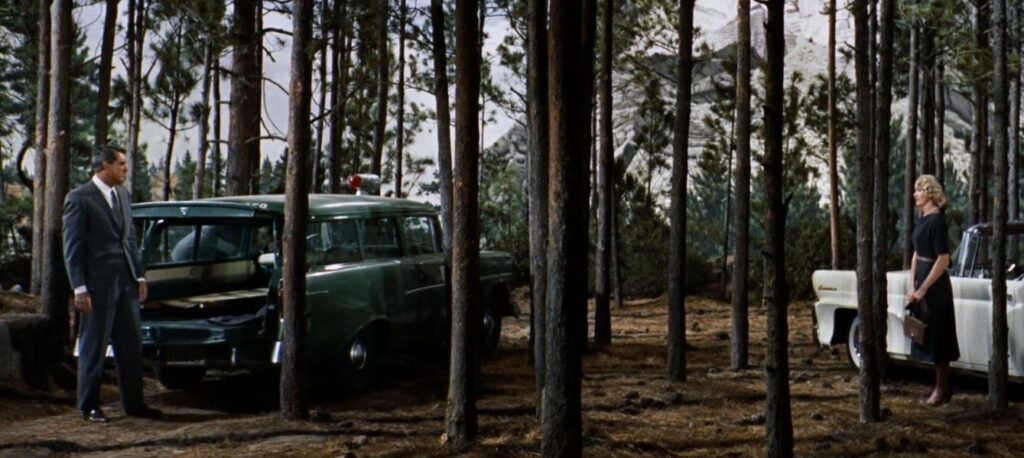
Finally, the film’s greatness lies in its technical mastery and cohesion. Every camera movement, every cut, every bit of sound and music contributes to the rhythm and mood of the film. The result is a movie that works on multiple levels: as a suspenseful thriller, as a character study, and as a carefully crafted visual and auditory experience. It’s this combination of technical perfection, thematic depth, and sheer cinematic artistry that has kept North by Northwest revered for decades.
Yeah. But I’m not going to do that. I’m not going to rehash what every other so-called expert on the planet is prone to yelp when it comes to this movie. Instead, I’m going to tell you what I think of it. I think that somewhere in the 50s, Hitchcock looked at the world he was living in and thought, ‘What if we take a man who is 100% a product of this superficial and ultimately fake society we’re trying to create here, and subject him to real danger? What would he do? How would he react?’ and then went about making this movie, the same way any true master of his craft does anything; to us, mere mortals, to the very highest of standards, but for himself, without effort or hesitation.

Leave a Reply