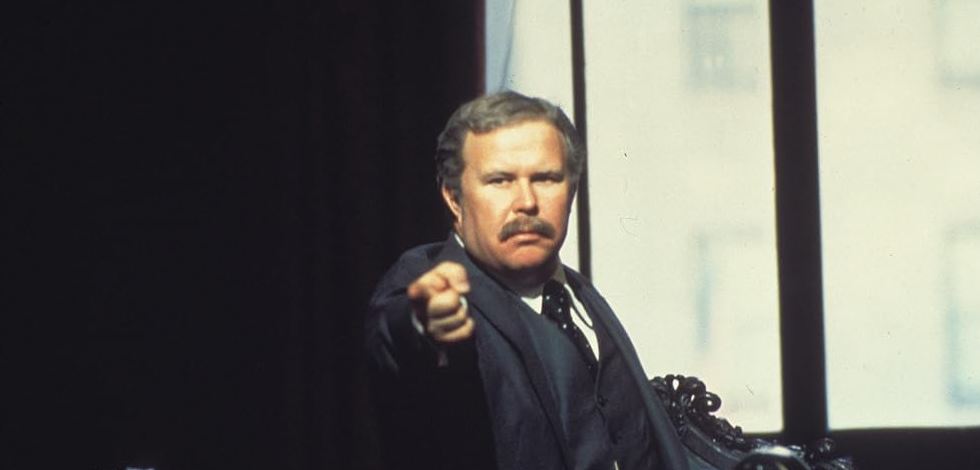
Due to popular demand, I have decided that my newly minted “Men of Consequence” series will pivot, buck convention, and add an entry that doesn’t involve beating some lippy broad to a pulp. Oh, believe me, we’ll return to familiar ground soon enough, but for now, it’s time to explore a new kind of masculinity. A less physical variety, and one not even remotely handsome. A man in a suit, yes, and one with a great deal of power and influence, but he’s more the board room type, with the distinct possibility that he doesn’t even think about sex. A man of the 1970’s, when we all lost our marbles and chased the illusion of happiness like it was a line of coke on a toilet seat. A time of recession, depression, gas lines, and disco. One of the worst times to be alive in America, except for the cinema and an occasional novel. A time for Network, when Sidney Lumet and Paddy Chayefsky joined forces to burn down what was left of the can-do spirit. We’ve never fully recovered, thank Christ.
While the entire cast sets the screen aflame, let’s narrow things a bit and shine a light on one Arthur Jensen (Ned Beatty), the head of a fictional television network who also just happens to be a raging psychopath. Which is fine, as few with sanity and any semblance of decency could be expected to both adhere to principle and turn a profit in the same lifetime. He’s beyond barmy – barmier, even, than the “Mad Prophet of the Airwaves” himself – but he understands the zeitgeist better than anyone ever could. He is, in many ways, ahead of his time, though he channels capitalism’s origin story as best articulated by the creed of Adam Smith: everyone and everything is for sale, so take your share of stock and keep your mouth shut. Utter resignation to the inevitabilities of the economy is his mantra, and he needs Howard Beale to sell it. Nightly, preferably, so that the masses lose their souls faster than usual. And even when people revolt, turn the channel, and ratings dip, he’s still to be kept on the air. This one and only time, we’ll risk the revenue. There are larger issues at stake.
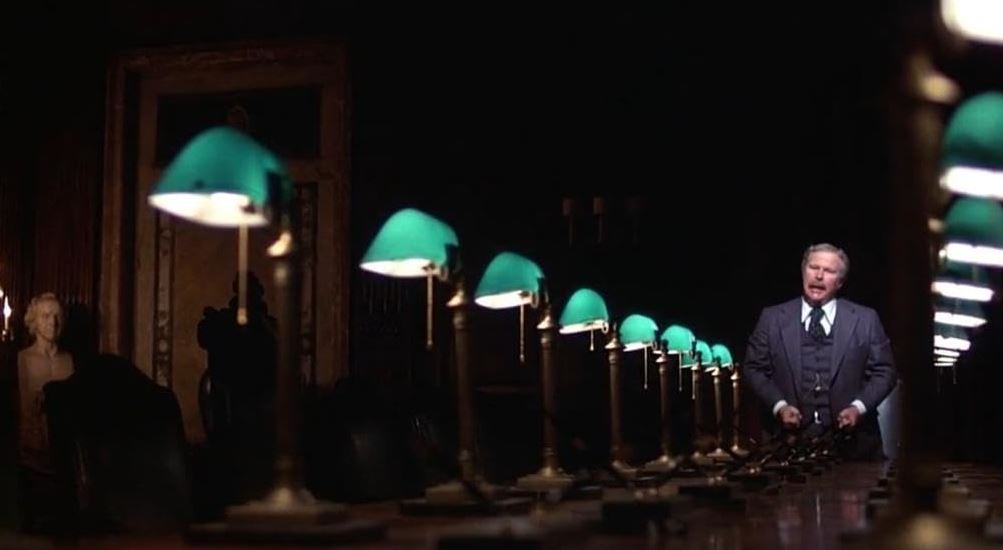
Mr. Jensen has but one scene, of course, but that’s all he needs. Lit just so by the soothing glow of perfectly placed lamps on a table that flirts with endlessness, he is, in Howard’s parlance, the “face of god,” a notion Arthur makes no effort to contradict. For he is, in this context, a deity of sorts, reducing the world entire – and our place in it – to the “immutable bylaws of business.” We can talk about love, or culture, and the wars both produce with alarming frequency, or we can dispense with all the nonsense and get down to reality. “The world is a business, Mr. Beale…It has been since man crawled out of the slime.” We can spit and roar about competing ideologies until our faces turn a deep shade of blue, but regardless of time or place, what it all comes down to is a race for dollars. Unshakably depressing, yes, but in its own way, the only road out of this mess. To know that, despite the division, we’re all so affixed to an ultimate purpose that the differences start to disappear into the mist. They are, ultimately, superficial at best.
The primal forces of nature, indeed. Fixed as a lodestar, and as essential as our very DNA. When I was younger, I used to think that Mr. Jensen was simply trying to cover his ass over a blown business deal. And hell, that’s certainly part of the issue. But as the years accumulate, and my hold on despair becomes ever-tighter, I have put away childish things and embraced the essential message tucked away somewhere amidst the seam-splitting suit and get-fucked moustache. Inspired by Arthur, unfurled by Howard: “It’s the individual that’s finished.” And that, as they say, ends all that “mad as hell” business. We, the saps, easily riled up for a cause, later blown apart by the cool wind of resignation. For it is idealism itself that Arthur polishes off like an after-dinner cigar. Our shouts, our marches, our righteous indignation, all for naught. It meant – and means – nothing. Because they win. It wins. Always. Just as every revolution becomes what it replaced, every push towards a better life succumbs to the ultimate reality that nothing of value lasts unless you can pay for it. And to make money, you have to join up. With all that entails.
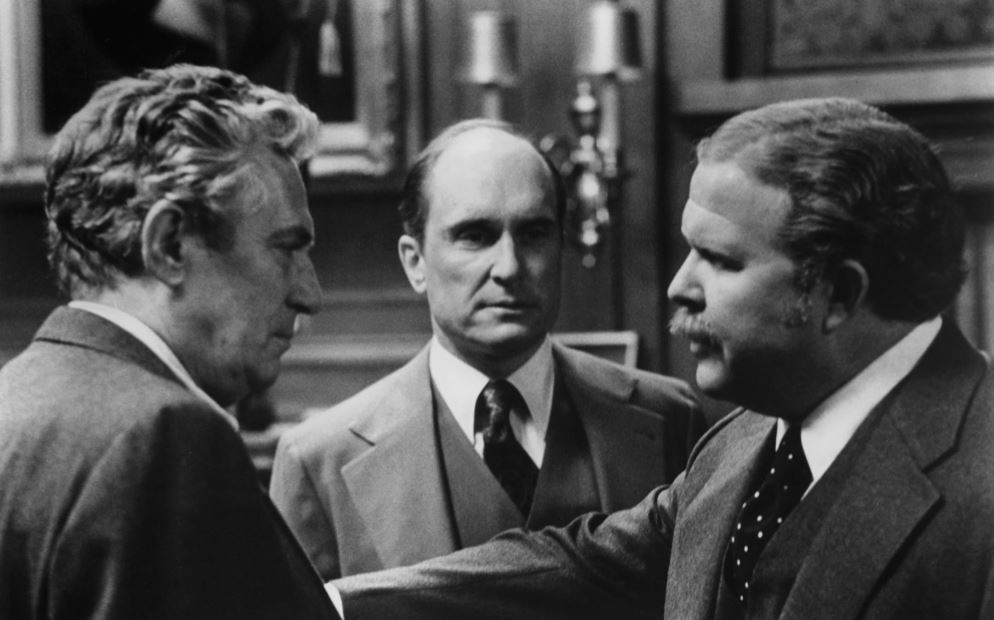
In the end, Arthur Jensen is the last, best hope for a breed of masculine virtue that seems to have devolved into little more than a newer, more restrictive resentment. It’s almost all the way there, but it can be saved, simply by telling the truth. Which is why we instinctively recoil in the face of Jensen’s monologue, only to come to our senses once we’ve made peace with our compromises. “You get up there on your little 21-inch screen, and howl about America, and democracy,” he begins, the bombast reduced to a conspiratorial whisper. “There is no America. There is no democracy. There is only IBM, and ITT, and DuPont. Dow, Union Carbide, and Exxon. Those are the nations of the world today.” Different names and logos now, of course, but corporations just the same. Our masters evermore, and the only way it can ever be. Arthur knew, and you’d better.
Leave a Reply