For a long time, Irish talent in Hollywood occupied a specific, slightly cramped lane. You had your character actors and your occasional brooding leads, but they were rarely the sole reason a film got greenlit. That dynamic has shifted properly now. Look at the festival circuits or the streaming heavyweights over the last eighteen months and the pattern is obvious. Irish actors aren’t just present; they are the engine room of the current industry.
This goes beyond simple representation. It’s about bankability in a fractured market. When audiences are faced with a paralysis of choice on a Friday night, scrolling through endless rows of identical-looking thumbnails, recognisable talent becomes the deciding factor. We are seeing a move where the actor is the genre. You don’t watch a “historical drama”; you watch a “Cillian Murphy film”. That shift in viewer psychology has placed Irish performers front and centre of the global conversation.
Colin Farrell: Ballad of a Small Player
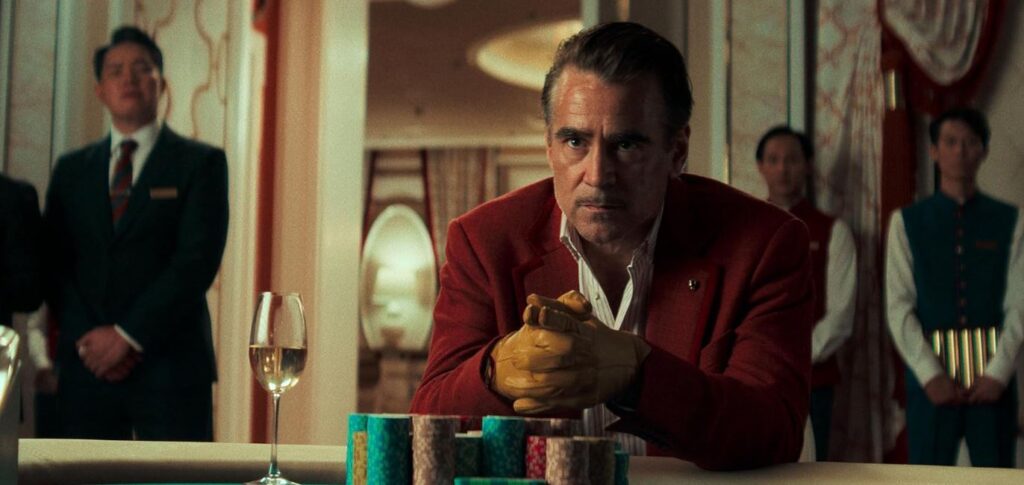
Colin Farrell’s recent career choices have been impeccable. After the heavy prosthetics of The Penguin and the rural melancholy of Banshees, he is pivoting to something sharper with The Ballad of a Small Player. Directed by Edward Berger, who has plenty of capital in the bank after All Quiet on the Western Front, the film adapts Lawrence Osborne’s novel about ‘Lord Doyle’, a conman posing as an aristocrat in the sticky heat of Macau.
This isn’t the polished gloss of Ocean’s Eleven. It looks to be a study in desperation and superstition. Tilda Swinton joins the cast as a kindred spirit, suggesting a film that is going to be heavy on dialogue and atmosphere rather than just heist mechanics. It is the kind of role Farrell excels at: charming, broken, and frantically paddling beneath the surface while the walls close in.
The film frames the casino floor as a theater of high drama. This is the Hollywood version of the pastime, worlds away from the reality of players scrolling NetBet for free spins from the comfort of their sofa. Berger isn’t interested in that casual reality; he wants the sweat and the panic, and Farrell is the perfect vessel to deliver it.
Barry Keoghan and the Saltburn Effect
If Ballad of a Small Player represents the prestige end of the wedge, Saltburn was the sledgehammer. While it has been a couple of years since Emerald Fennell’s class-war satire landed, it remains the defining text for understanding the current Irish wave. It wasn’t just that Keoghan played the lead; it was that he made Oliver Quick, a character who could have been a generic sociopath, into something terrifyingly pathetic and magnetic all at once.
The film worked because it refused to blink. It was a nasty, stylish piece of work that required a lead actor capable of shifting from awkward outsider to predatory force without the audience seeing the gears turn. Keoghan has that ability to look completely innocent while signalling total danger. That performance proved that Irish talent wasn’t just there to add local colour or play the best friend. It showed they could carry a film that was designed to be divisive.
It also changed the algorithm. Saltburn lived and died on social media clippings and reaction videos. It proved that a performance could go viral in a way that traditional marketing campaigns struggle to replicate. Keoghan didn’t just act in a movie; he generated a cultural moment, and that kind of impact is currency in the modern landscape.
The Foundation: The Banshees of Inisherin
If we are tracing the root of this specific moment, we have to look back at The Banshees of Inisherin, which narrowly missed out on the list of the top 25 movies of the 21st century. It didn’t just re-establish the Farrell-Gleeson dynamic; it served as a showcase for the depth of the bench. Kerry Condon and Barry Keoghan didn’t just support that film; they stole large chunks of it.
That was the turning point. It proved that these actors could carry a film that was hyper-local in its setting but universal in its misery. It confirmed that the Irish accent wasn’t a barrier to global distribution, provided the performances were grounded enough.
Why 2026 Looks Different
The difference now, looking ahead to the 2026 slate, is that the “Irish actor” is no longer the interesting side character. They are the engine.
This matters because of how we watch movies now. In a streaming-first ecosystem, the “thumbnail decision” is everything. Audiences are less likely to take a punt on a high-concept plot than they are on a face they trust. Actors like Paul Mescal, Saoirse Ronan, and Farrell have become shortcuts for quality. If they are on the poster, the viewer assumes the script has a certain weight to it.
We are seeing a move away from the glossy, committee-designed blockbuster towards darker, performance-led thrillers. That is a playground where Irish theatre-trained actors thrive. They bring a specific gravity, a willingness to look unglamorous and desperate, that American method acting often struggles to replicate without feeling forced.
Final Cut
The “Irish Wave” isn’t a trend anymore; it is the new baseline. The industry has realised that if you want a film to land with critics and actually hold an audience’s attention on a distracted Friday night, you cast from this pool. Ballad of a Small Player is the perfect example of where we are heading: high-prestige directors, complicated anti-heroes, and Irish talent right at the centre of the frame.
Leave a Reply