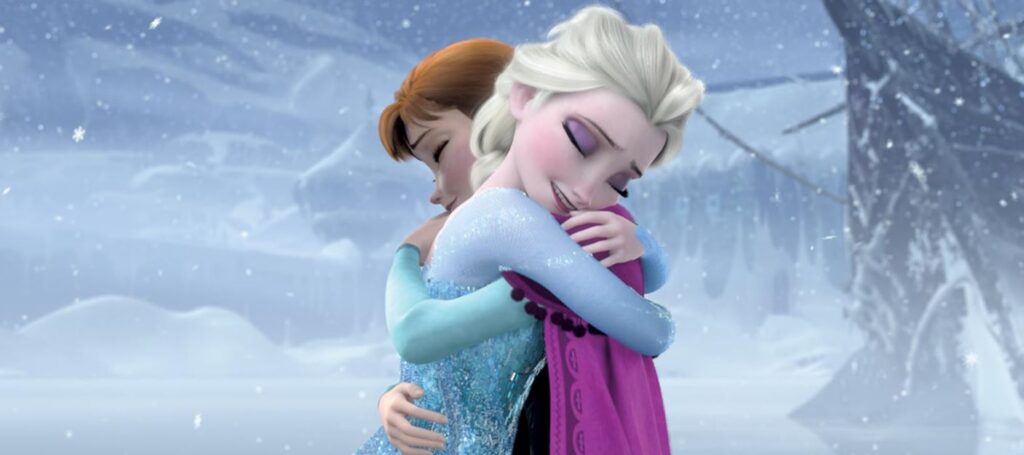
Hello, person. Please allow me, first and foremost, to introduce myself: my name is Kierkengaard von Brunhofen, and I would like to share some thoughts with you about the movie Frozen. Although, to call this exceptional, deeply moving and transcendent material simply ‘a movie’ is to refer to the Grand Canyon as a mere ‘geographical feature’. So, please, person, come sit now, here beside me, while I guide you into what just well may be the most transformative experience of your life. Thus:
If Plato himself were to gaze upon the icy spires of Arendelle, he would not see them as mere environment or setting. He would understand Elsa’s palace as the ideal made manifest: a visible form of the invisible order, the place where the essence of identity and being steps out of abstraction and becomes, unmistakably, itself. In her isolation and creation, Elsa is not simply “finding herself”; she is giving physical shape to the eternal struggle between who we are and who we are told to be. The characters around her—Anna, Kristoff, the villagers—move within that tension, acting out the same conflict that Plato believed defined the human soul: the pull between reason, desire, and spirit, each of them flickering like torchlight on the wall of the cave. Frozen dramatizes the very thing philosophy has wrestled with since its beginning: the way freedom can feel like exile, and how truth often arrives wearing the cold face of fear.
Nietzsche, too, would have recognized something essential here. “Let It Go” is not just a catchy anthem; it is a declaration of becoming, the moment when the individual steps beyond imposed morality and embraces the terrifying clarity of self-created meaning. Elsa is not rebelling out of anger. She is stepping into a world where she alone defines the terms of her existence. Even Olaf, the seemingly innocent snowman, represents something profound: the absurd joy of choosing to love and to hope even when the world appears indifferent or even hostile. In this sense, Frozen does not merely tell a story. It illustrates the entire arc of human selfhood — the struggle to break free, the fear of the unknown, the beauty of connection, and the miracle of choosing, again and again, to care.
To conclude, dear person: Frozen, is not merely a triumph of cinema, in my humble opinion, but the very pinnacle of all human cultural creation — past, present, and conceivable future. Its narrative elegance, emotional depth, and harmonic resonance combine into a singular experience so radiant, so flawless, that every other work of art — symphonies, novels, paintings, films alike — can only aspire, in vain, to touch even a whisper of its perfection. It is not simply a great movie; it is the ultimate crystallization of imagination and feeling, the summit toward which all human creativity has ever climbed. After Frozen, all peaks seem gentle hills. The zenith has been reached. This is it. We have witnessed the highest apex of aesthetic and emotional possibility — and for that, the world can only sigh in awe.
I thank you.


Leave a Reply