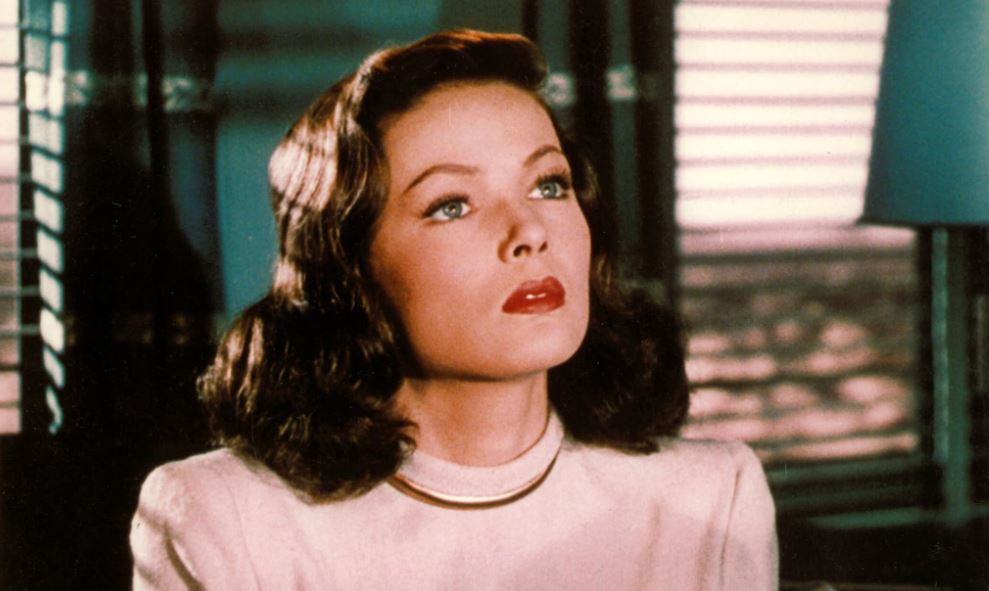
Gene Tierney, Leave Her to Heaven (1945)
The key to stardom, in any age, is all about that first impression. It can be full of fireworks, yes, but for that top tier of talent – the rarefied air of classic Hollywood glamour – it’s just as easily achieved in the prone position. Or sitting down in a train car, reading a book. Time Without End, more specifically, which is just what we feel when the tome is lowered and that glorious face comes into focus. At that moment, we are all Cornel Wilde (Richard), so transfixed as to be rendered deaf and dumb all in one shot. The lipstick, the hair, the regal bearing that promises the world and just as readily guarantees a lifetime of pain. Those eyes that betray nothing but an insistence on unconditional surrender.
She is Gene Tierney. Her character is Ellen Berent. She’s deranged, suicidal, homicidal, and utterly without scruples. A woman who loves too much, which is the decade’s way of saying she doesn’t love at all. That she’s mind-blowingly beautiful is a given. That we’d sell all, right down to our very souls, to spend an hour in her presence, is doubly so. And it all starts with a little chivalry. Picking up her book as she appears to lose consciousness to an especially acute case of narcolepsy. You dropped this, ma’am, assuming noble intentions. Only God himself had her pegged as Murder, Inc. Dressed to the nines to maximize confusion.
In any other year but the one Joan Crawford donned NFL-level shoulder pads to inhabit Motherhood incarnate, Gene would have walked home with the Oscar. Her femme fatale remains the best we’ve ever seen, and when you’re not above murdering a child, you’ll shoo away all comers for generations to come. She’s fevered, unhinged femininity at the top of her voice, putting the world on notice that the best way to ensure loyalty is to keep ‘em guessing. If you genuinely have no idea whether your evening will end with an orgasm or an autopsy, you know you’ve struck gold. Leave her to heaven, indeed. Not even hell knows what to do with her.
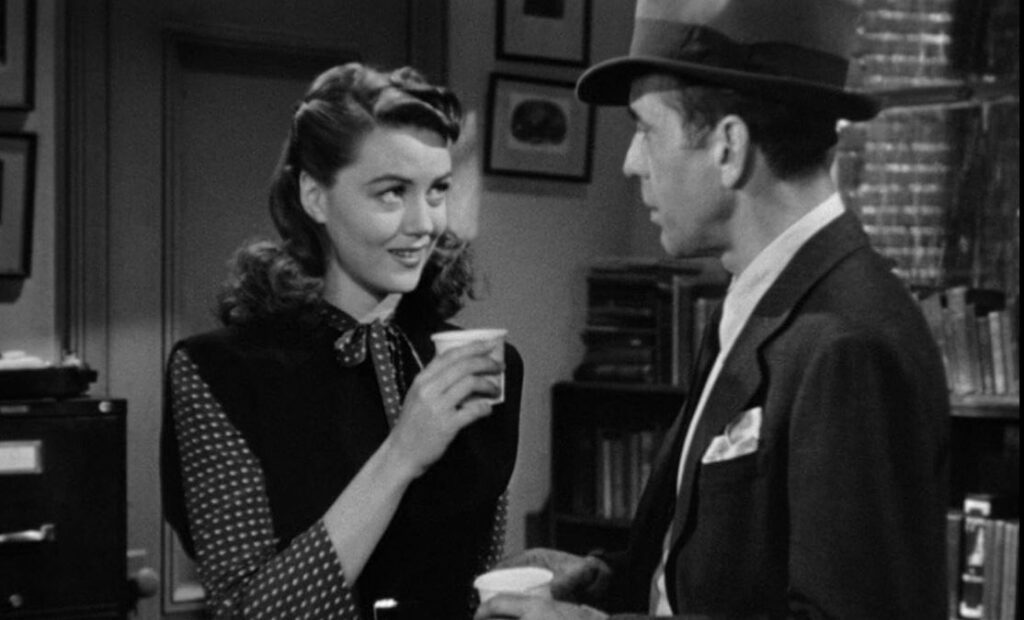
Dorothy Malone, The Big Sleep (1946)
Three minutes. Maybe the greatest three minutes of all time. A pair of glasses, a ponytail, and the world’s most Freudian pencil. Her face, difficult to decipher, except when she’s licking her lips. Just so, because she’s not that kind of girl. Only she is. Must be, if the world is to make sense. Then again, how many bookstore employees are handmaidens to danger? Maybe just the one. This one. A woman who knows her trade so well, she’d be ready for the day when he walked in. Could be anyone, but it’s most likely a guy like Bogey. Because that’s the America of 1946. Armed only with a few nonsensical questions and a hidden bottle of rye, he’s forever and always what a rainy afternoon promises but rarely delivers. And it took Howard Hawks and Raymond Chandler to bring it all together. Even if it never does make a lick of sense.
I’d provide a name, only she doesn’t have one. “Acme Bookshop Proprietress” is all we’re going to get, and frankly, it’s all we really deserve. She’s worked hard to get to this spot, and labels are precisely what she doesn’t need. Fill in the blanks and roll the dice, just like we used to when taking chances wasn’t an act of war. She has an eye for detail and can size a man up with only a cursory glance. “You begin to interest me, vaguely,” she purrs, which in this life and the next is enough for a full-tilt commitment. She knows what she wants but isn’t about to sign on before she’s taken the goods for a spin. It gets lonely at Acme, what with a life of the mind erasing all traces of heedless passion. It’s about time a man stopped by who offered more than a lecture. For him, she’ll draw the blinds. It may be her last chance.
If Miss Acme resonates – and she does, like an atom bomb on a Hiroshima morning – it’s because, at last, we have a woman of the time who reeks of lust without having to let her hair down. And the spectacles? They’ll stay on, thank you, because she needs to see everything in living color, even if one simply has to believe that her world remains black and white. She chose this life, teeming with words, and all she needs now to set the world back on its axis is someone equal to the task. Heady, yes, but one who can make the abstract come alive with possibility. Sure, Philip Marlowe is rough and tough and brimming with confidence, but even he knows he has to suck in his gut now and again to maintain an image. But this dame has him pegged. Yessir, from moment one. And all it took was crossing the street, fighting off a little drizzle to reach his destiny.
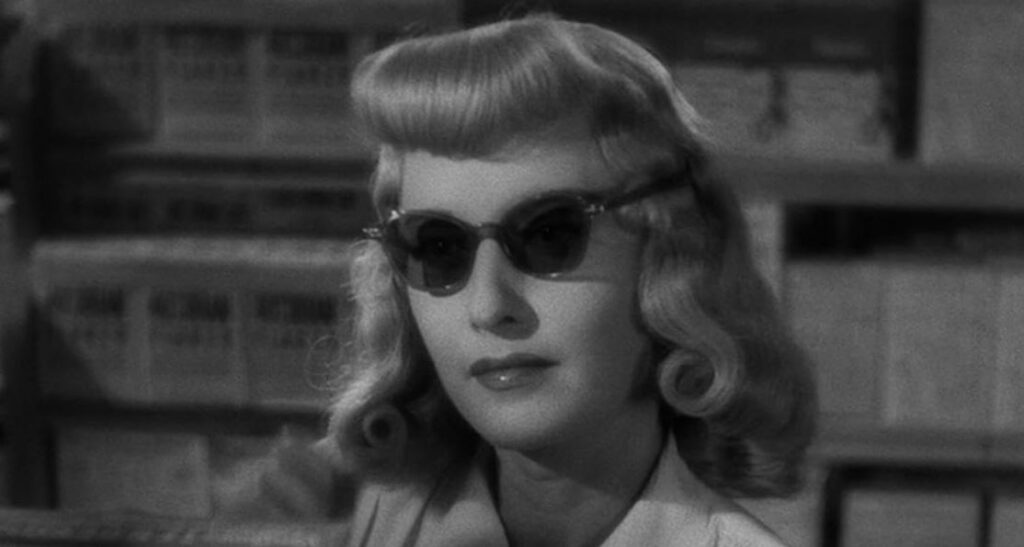
Barbara Stanwyck, Double Indemnity (1944)
Phyllis Dietrichson. On its face, a matronly blue hair bent on a canasta game to round out her day. Or a librarian, playing out the string of a life long since over and done. At best, a wifey-poo without the sense God gave her. But when the great triumvirate comes to call – Wilder/Chandler/Cain – along with Babs Stanwyck at the peak of her powers, we’re entitled to no less than an earthquake. A woman for whom sex is a weapon, and one best used for maximum gain. Where all men are suckers, because they can be had for the price of an anklet on a warm afternoon. Interchangeable, because that’s how they arrived from the factory. I’m only taking advantage. And why not? Girl’s gotta eat. One after the other, again and again, because I can always retreat to my helplessness. Bottle this shit, and the Holocaust would seem like a carnival. If there’s regret, it’s because she won’t look good in prison denim.
If film noir is to mean a thing, it’s that all men, given the opportunity, would throw their lives away for sex. Yes, it’s better if that sex carries with it a possibility for doom and gloom and bodies on slabs, but that’s for post-coital pillow talk. Until then, it’s enough to believe the here and now will last forever. Phyllis, then, is the eternal present. Worth dying for because, at bottom, you don’t really believe you’ll have to. Somehow, you’ll get out of it. You’d be the first, but doesn’t everything require a trendsetter? Why not me? Walter Neff is just such a dope. He knows better, but his penis long ago set the agenda, and penises aren’t known for putting things to a vote. Authoritarian organs by design, after all. It’s quite conceivable that Walter harbored a murderous thought or two over the years. Maybe even dropped a hint to see who’s biting. It took Phyllis to square the circle.
“I think you’re rotten,” she says that first visit, knowing exactly how he’d respond. “I think you’re swell,” he replies, “so long as I’m not your husband.” Shameless flirtation disguised as sniping. “Get out of here,” she spits, again predicting the retort. He obliges: “You bet I’ll get out of here, baby. I’ll get out of here but quick.” But he’ll be back. He knows it and she knows it, as if mankind ever offered an alternative. Had it been nicer, they’d have left it there, dangling for all time. They had to hate each other first before they could proceed. And Phyllis makes that easy. Her life of wealth and ease has made her soft-headed, but far from soft. Every waking moment she’s crafting and deliberating, taking mental notes for just the right moment. Sometimes she has to pound the pavement, other times they come right to your front door. Some leg to start, with honeysuckle as the closer.

Leave a Reply