
When the American Film Institute released its “100 Years…100 Passions” list of the greatest love stories of all time, Sydney Pollack’s The Way We Were clocked in at #6, just behind such immortal classics as Casablanca, Gone With the Wind, and An Affair to Remember. Sure, that same list also saw fit to honor Gigi, a morally reprehensible musical atrocity with the single, ignoble goal of pushing Maurice Chevalier’s rape-filled fantasies, but who am I to argue with the stamp of officialdom? The people, as they say, have spoken. But, per usual, they have spoken with the forkiest of tongues, confusing narcissistic manipulation for amour, sadomasochistic dependency for romance, and, above all, humorless fanaticism for purpose. Where some saw tears and toil, sacrifice and devotion, I saw two centuries of femininity compressed into a seething ball of rage. A ball of Babs.
Maybe it was Robert Redford’s golden locks that distracted us. Or Streisand’s unmatched vocals during the opening credits. Whatever the cause, the nation collectively swooned, hoping against hope that two kids from opposite sides of the political spectrum could make a go of it. Because, well, we want to believe. Love must triumph, lest we stop and wonder why 98% of all literature, poetry, and popular music have forever and always been devoted to bullshit. In our own lives, we date, marry, and start families on little more than hopes and prayers, and if we were forced to step away for a month or two to assess the practical reasons for going forward, no one would end up together. Not a single coupling could survive such scrutiny. There’s a reason why “Fools rush in where angels fear to tread” is practically the anthem for humanity.

But we’re here for Barbra and her Katie Morosky. She’s the living embodiment of evil, truly, but I’ll give her this: she’s utterly timeless. Though the movie is set in the 30’s and 40’s, it hasn’t aged a day. The players have changed, as have the fashions, automobiles, and hairstyles, but not the essence of youth. Here, Katie roars for the oppressed masses of revolutionary Spain. Now, she’d spit and slobber for Gaza. Every waking moment of her life was a battle for truth and justice, turned slightly askew by her embrace of Stalin. To her, it’s just good old Uncle Joe. She even has his portrait in a privileged spot in her modest apartment. In this way, it’s as if she traveled forward in time to fundraise for Queers for Palestine, failing to notice – quite deliberately, I believe – that Islam long ago declared homosexuality incompatible with staying alive. But Katie marches on, even painting her kitchen a glorious Soviet red; forever in compliance with the company line.
But of course, there’s more. Though well past the age of thirty, yet passing for a college student, she believes that in order to demonstrate compassion for the world’s suffering, she must forego all joy. Not a trace of mirth, lest we forget the starving millions. Mere banter or conversation? Consigned to the dustbin, for if we’re not perpetually arguing, lecturing, and demonstrating our superiority, we’re succumbing to superficiality and moral abdication. A party can never just be a party; it must be a battle of wills from the moment you hang up your coat. The world is thereby reduced to winners and losers, oppressors and oppressed, with the sidelines reserved for those who wish to tolerate evil. Yes, Katie’s worldview is that black and white, and her reduction of every waking interaction to such binary simplicity is, again, to demonstrate how little we’ve changed since the end of WWII. Totalitarians, then and now, at the forefront of peace and freedom. Naivete writ large, with assassins resurrected as heroes.
So as Hubbell (Redford) and Katie have their meet-cute (naturally, it begins with her failing to laugh at a joke) and commence courting, we realize with a shot that we’ve been here before. Cinematically, that is. In fact, it was just three years prior. Indeed, my friend, this is nothing more than an update of Love Story. Only without the fatal disease. But there, the annoyingly vapid female had the good sense to die young. Katie, on the other hand, survives and thrives, only without maturing a single iota. When we leave her, there she is, protesting not nuclear war itself, but America’s insistence on possessing such weapons. That she doesn’t screech as incessantly against the USSR’s arms buildup is telling, but suitable to her demented worldview. Only America has used one of the damn things, so they are eternally the bogeyman. Again, it’s too much like the kids of today. The West, tagged as evil colonizers bent on world conquest, while simultaneously ignoring the same map charting Islam’s 1000-year war of subjugation. We are, therefore, all Katies now: assigning blame not because it’s historical, or factual in any nuanced way, but because it upholds the narrative. Chip away at that, and you just might realize how much time you’ve wasted in support of a lie.
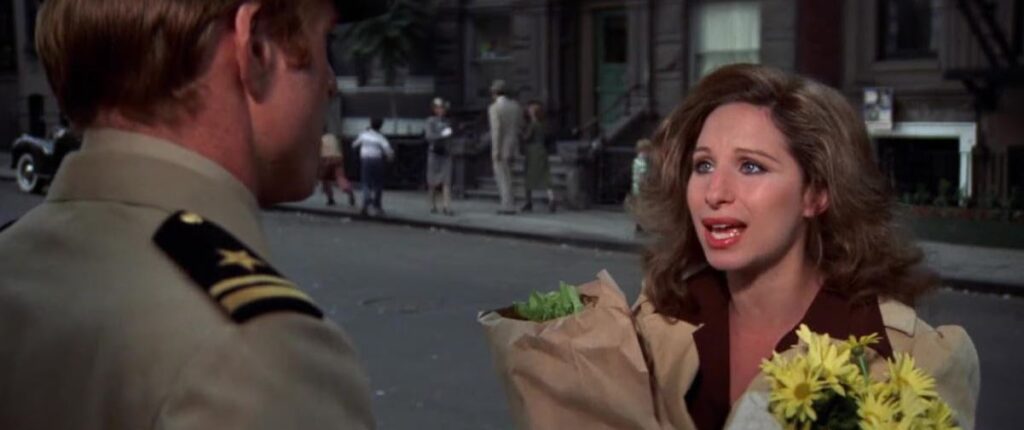
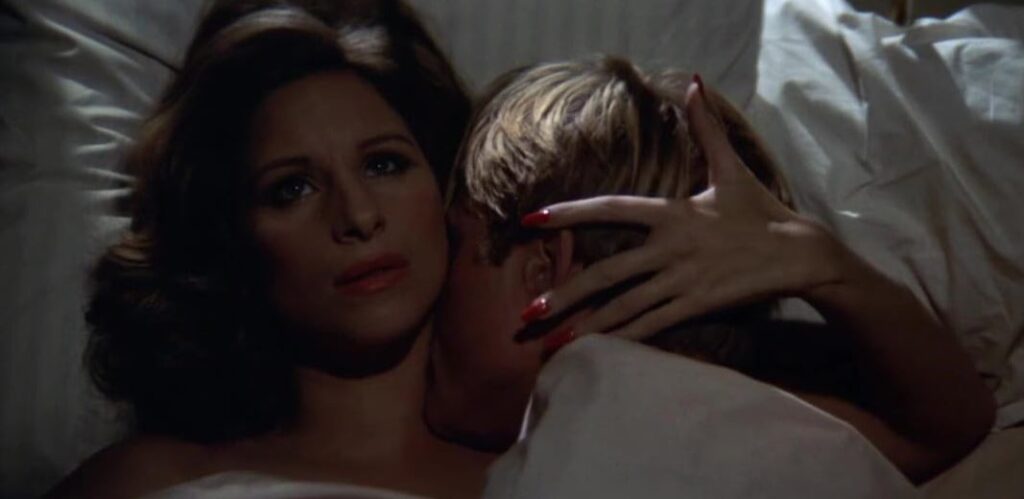
As I watched this clusterfuck of tirades and tears, I couldn’t help but ponder the title: The Way We Were. As it rolls off the tongue, it almost insists on its own sentimentality, conjuring up visions of a hazy, yet bountiful past, full of warm embraces, fireside flirtations, and promises fulfilled. Sure, the whole romance fell apart, but wasn’t it glorious….then? Only it wasn’t. Not for a single moment, even when Babs contrived to have a half-conscious – and very drunk – Hubbell essentially mount her without knowing what the hell was going on. I’d call it rape, but it was Hubbell who didn’t give consent. Not a single scene showed them enjoying each other’s company, and the happiest Hubbell appeared was after he had an affair with an ex-girlfriend. Hubbell was ostensibly a writer, but the only thing he produced was a novel called A Country Made of Ice Cream, a title so patently absurd one doubts the book would have even made it to the self-publishing phase, let alone be adapted by Hollywood.
I’d like to think the entire enterprise was a cruel satire of love in America, or even love stories as told by the dream factory, but to know that everyone meant it is to understand the basic flaw in the national character: while immersed, we can’t perceive our own downfall. Just like the woman who insists that her husband’s fist meeting up with her teeth is a misunderstood love tap, The Way We Were’s staggering box office success (and enduring appeal) speaks to a population unwilling to admit that treating each other like shit is not romance, but its unshakable opposite. I mean, if anyone used this movie as a template for what is or should be, it’s no wonder we’re all confused. As such, I’d also like to think that a bootleg copy made its way into Japan and singlehandedly convinced its own young people to stop fucking. Absence should only make the heart grow fonder if the person absent wasn’t a raving lunatic.
In sum, Republicans and Democrats should never date. Sex is permissible, but keep it strictly transactional. Further, if you still believe at 50 what you did at 20, your life has been an absolute waste of time. If getting older is to mean anything, it’s being able to stand in a privileged position and judge the fuck out of what we used to be. Third, while mosquitos technically remain the biggest mass murderers in history (killing an estimated 52 billion people throughout time), the greatest threat facing humanity is actually idealism. Just as a skeptic never joined a cult, nor an atheist ever cried out “why me?”, the hard-bitten realist – with the requisite realpolitik to match – never ascribed evil to a single group. The whole barrel is rotten, privileged and poor alike. Just a matter of who happens to wear the crown.
Katie’s mistake wasn’t in being political but childishly believing that in the war between fascism and communism, a winner could emerge. Or that revolutions could ever produce meaningful change, when the only difference between the victor and vanquished is a change of clothes. But above all, ladies and gents – mostly gents – I appeal to your good sense. If you must date, use but one standard for whether or not a first leads to a second. Examine her living space. Open every door. Check all the walls. Bad taste? Forgivable. Messy, unkempt? A possible red flag, but not a game changer. Framed pictures of mass murderers? Turn on your heel, friend, and never look back.


Leave a Reply