
Don’t snort, you had no clue what was going on, admit it.
The Duke brothers trade commodities, on a dollar bet they decide to switch the fortunes of two men, one, their hardworking future-grand-nephew Louis Winthorpe III and, two, street begging black ne’er-do-well, Billy Ray Valentine, this by sending Winthorpe into the ghetto via planted drugs, and bringing Valentine to the C-suite to see if nature truly does trump nurture. While this is going on, Valentine discovers a plot to steal (by what means it never says) the government’s Citrus Production Assessment, on New Years Eve, three days before it’s set to be released. The two men tormented by the Dukes decide to fake the report, giving the Dukes phony information that once acted upon will make them overspend and, hopefully, go broke, while they take the good information to the trading floor and clean up.
What a horrible thing it is to realize that the entire final scene could not have happened, but even if it did, the payoff would be minimal. So, on this Christmas I give you the gift of clarity to one of the most poorly mansplained scenes of the late 20th century.
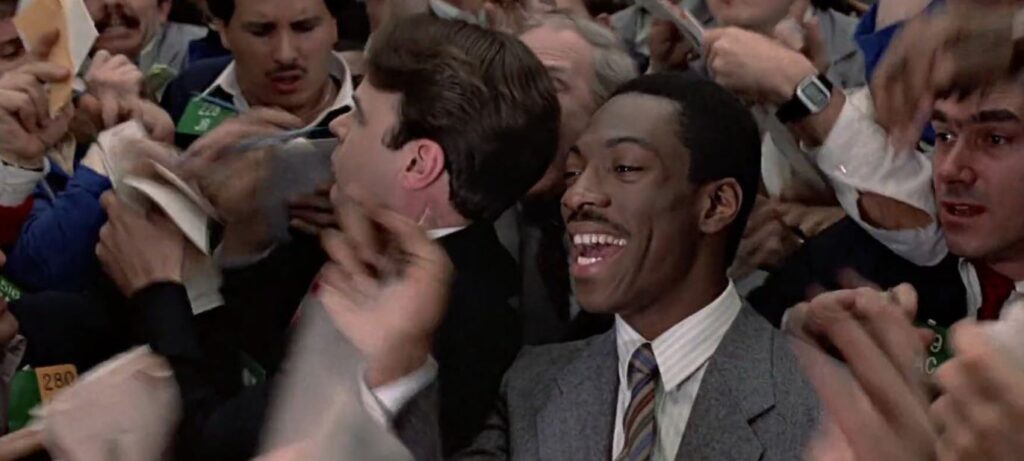
We all remember the scene, Dan Akroyd and Eddie Murphy arrive on Wall Street before the bell, we must assume a few things to explain their presence.
1. Ackroyd’s character already had a seat on the exchange.
–”This is the last bastion of pure capitalism on Earth.” meaning, ‘we take all comers’. Um, yes but no. A seat on the exchange in 1983 was expensive, roughly 300k. Winthorpe seemed independently wealthy and maybe could have pulled a private seat, but if you forked out 300 duckets for the privilege of early on-set hypertension, would you be sitting on your fat ass at Duke&Duke.
2. Eddie Murphy, somehow, got credentials, SEC approval, and a passed a credit check at 8 AM the day after a federal holiday.
–New Year’s Day. Federal Holiday. Nothing open. The crop report was to be announced one hour after the bell on Jan 2nd. They got there in time for the bell, 9AM. So, the check/doublecheck/colon exam it actually takes to get SEC approval to be on the floor, not to mention the printing of credentials and making sure you’re solvent, happened…I dunno, in that inkling of mythological time when fairies and goblins meet to breakdance.
You could say all this was accomplished while he worked at Duke&Duke, but if they tried, he would have been rejected for security reasons (rap sheet), solvency issues (he made a living as a beggar), not to mention the Duke Brothers would not have put him up for floor access anyway, they already had a guy, that hapless bastard who passed out before Randolph had a heart attack.
Okay, let’s sprinkle some magic Disbelief Suspender on the situation to pretend it could have ever happened.
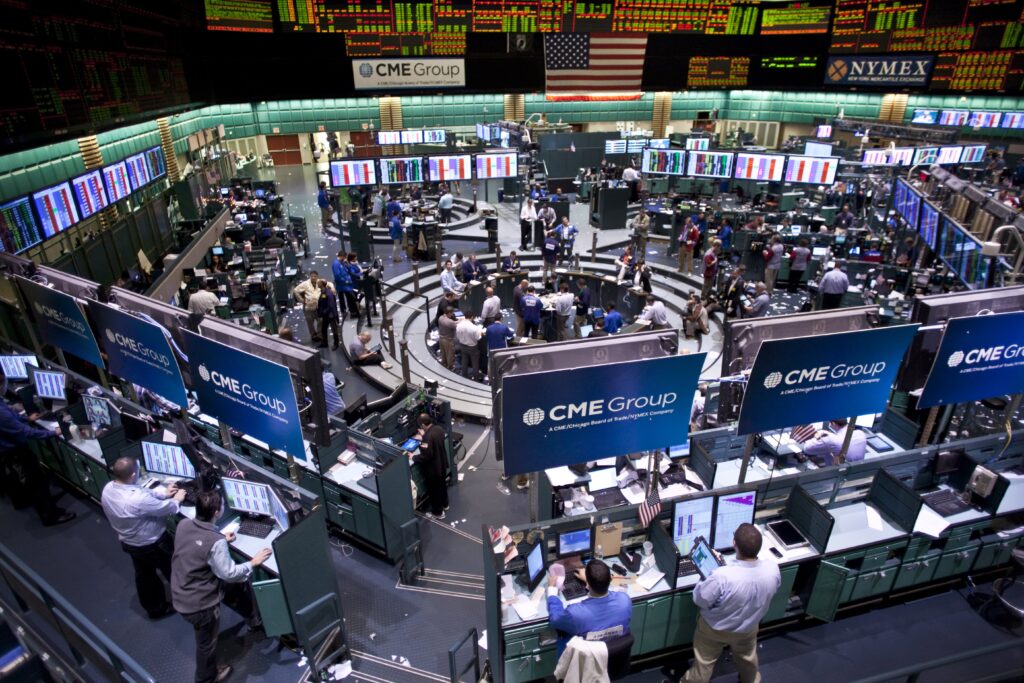
Where were they?
–NOT the NYSE! Frozen Concentrated Orange Juice is not traded at the stock exchange—stocks! are traded at the stock exchange—commodities are ( or were) traded at the New York Board of Trade (but alas, ‘open outcry’ trading doesn’t even exist much anymore, I lament the passing of these dramatic, masculine elements of culture, a pox on the feminine gentility of our digital Manchuria— odd, isn’t it? like the Emperor’s court with 9 inch fingernails, the more refined we become, the uglier and more ridiculous we seem.).
[end brooding aside]
[Go to text body]
So, Ebony and Ivory march onto the floor, the Dukes, up there on the observation deck (the place Billy Ray Valentine would have been) instruct their runner to buy right from the bell.
FCOJ futures are bought and sold in 15,000 pound contracts, the price is in cents. The opening price in the scene is 102, meaning $1.02 per pound.
But first, what’s a ‘contract’?
A ‘contract’ is a way to lock in the price of an agricultural project before it is needed. Given the speculative nature of…uh, well, nature… a price must be established before the actual product is necessary for production.
You with me? No?
Okay. Imagine you are Breyer’s Ice Cream. You have to put out a million cartons of strawberry ice cream every fiscal quarter, in order for you arrange funds through a bank you have to know how much the strawberries will cost three months from now. You’ll know the price thanks to ‘contracts’ agreed to last fiscal quarter, where one guy is contracted to sell you a certain amount of strawberrieson a certain day, how he gets these contracts isn’t your problem (and how you actually get the strawberries isn’t his problem, you have an account with a logistics company that does the loading and shipping) all the contract owner does is lock in how much and when. Doing it this way gives you time to adjust your production, your loan parameters, it gives farmers a guaranteed price, which helps them borrow on and insure their crops, because they’re always one summer snow away from bankruptcy.
So, what makes the contract price go up or down?
The only thing that can: nature. Or, to make it more Adam Smith, the supply. Demand for your strawberries will remain constant, so it’s the projected supply that traders speculate on to make money. A hurricane hits Louisiana in June, the national supply of strawberries falls by five percent, so the price goes up by five percent, his contract, bought when prices were low, gains post-sale value that he can profit from, but if he predicted a hurricane and instead of going to Louisiana it ripsthe toupee off of Mexico, the strawberry market gets flush, supply goes up, his contract loses value. Traders need to guess what nature will do to make money, but it’s also necessary to guess, as in the case of citrus, what nature is doing, or has done. So, they often visit farms and ask about their yield, but no single farm can tell you about the entire nation’s output, so that leaves you with……stealing the government’s crop report three days before it goes public.
The Dept. of Agriculture maintains precise tabulations of every bushel, pound, bunch, crate and quart of nature’s bounty so we, as a society, can squeeze one more drop of profit from her purple tit. There is a citrus projection report, it will tell everyone if the supply of oranges, limes and kumquats has gone down in winter or remained steady or, in an unusually warm one, gone up. Because supply is the only price variable, and nature determines supply, knowing how cold weather is dutch-dooring a particular warm-weather plant would be profitable.
So, now are you with me? I think you are.
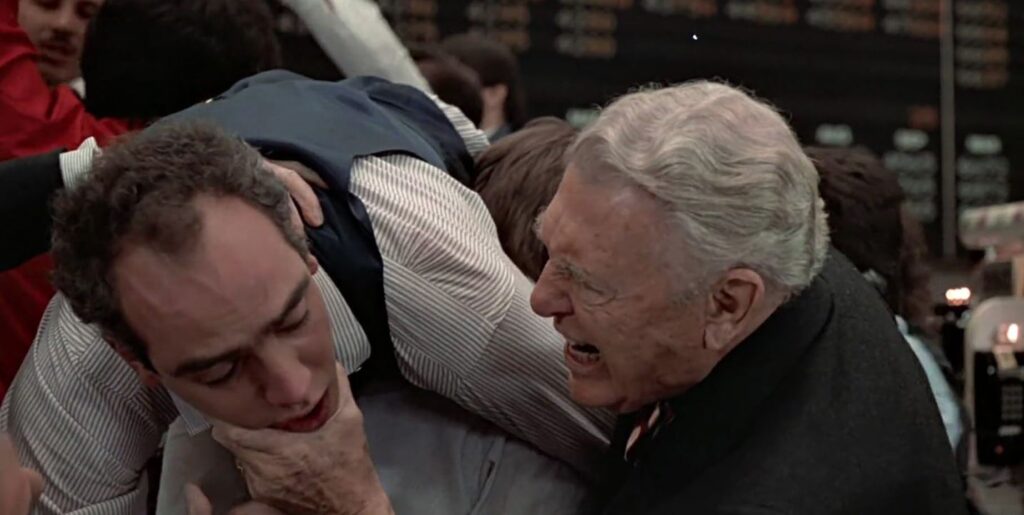
The bell rings. The Dukes start buying, the other traders follow because they think they know something, price shoots up. Winthorpe waits and screams ‘Sell 30 April 3rd at 142’ and they lunge.
What did he just say? He said I’m selling 30 15,000 lb. contracts at $1.42 per pound, available on April 3rd.” Everyone thinks that’s a great deal because—look at the board!— it’s there already. Remember it is January 2nd, April 3rd is three months or one fiscal quarter away.
But how does one get a contract to sell it in the first place? Answer: you don’t have to. Him just saying it is the contract is enough, commodities are settled at the end of the days trading, so it’s all virtual until receipts are printed.If you have a seat, you have an account that is debited based on sales, presumably this is where his hooker-girlfriend and butler’s money goes. So, Winthorpe sells his 30 contracts, the pieces of paper in his hand are slips detailing who wants what, this is taken to the hub where a sell-receipt is time stamped. The pandemonium we witness, where Winthorpe and Valentine point and nod at the violent throng then scribble something down, of course, would not happen. What would happen is this:
Winthorpe: Sell 30 April 3rd at 1.42!
Crowd: Yes! Me! I’m in!
Winthorpe: Let’s see’em!
[the runners scribble the price, the maturation date (apr.3) and the amount, —say, one contract—then initial. They don’t have to give their brokerage name, it’s printed on the slip before hand.]
Trader (to Winthorpe): 142 April 3rd, here.
[Winthorpe takes it, initials. Hands his paper to the hub-lady who stamps a card. There is a line for Winthorpe’s contracts, his thirty go quickly.]
Okay, so the scene has the price going down right then. It wouldn’t, not until they broadcast the crop report . So the Under-Sec of Ag comes on and says the ‘cold winter has not affected the orange harvest’, meaning the supply is unchanged, which means those contracts are waaaaay over-priced.
A bubble was created by the Dukes, it popped, everyone sells off and Winthorpe and Valentine wait for the price to drop.
But why?
Why don’t they just take their profit, why do they wait around to buy the cheap oranges?
Because they haven’t made a profit yet, they contracted themselves to sell 450,000 pounds of frozen concentrate on April 3rd….to sell…sell—you can’t sell what you don’t own, so in order to make any money they, at the end of the day’s trade, must own as much as they agreed to sell, they won’t make a dime unless they buy 30 contracts at the lowest possible price.
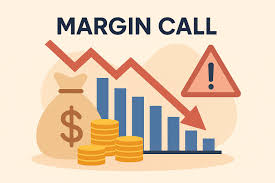
“Margin call, gentlemen.”
When you want to buy a lot of something on Wall Street but don’t have the cash, you take out a loan, called a ‘margin’, you pay ten percent of the purchase price, the bank pays the rest, if the stock goes up you take the white meat, if it goes down you have pay the bank. All accounts are settled at the end of the days trading and the Dukes tried corner the market—which means these greedy bastards tried to buy every drop of FCOJ in the country that would be sold on April 3rd, 100, 000 contracts, easy. They bought on margin, the contract flopped, now they owe 300+ million. Don Ameche says ‘Fuck him!” uttering his first curse word on film, which, as a strict catholic, almost made him quit the movie. (He relented, but told the crew before the shot ‘I’m going to have say something very bad, and I don’t want to do it twice so, please, can we try and do this in one take.” The crew gave him shit for it all day, dropping f-bombs within earshot as much as they could and then laughing. Ah, those wacky Teamsters.)
So the Dukes went broke, comeuppance received, but how much did Winthorpe make? Valentine said they had a bet for a dollar, “He bet me we couldn’t put ya’ll in the poor house and get rich at the same time.”
Well, honestly, they couldn’t, not with thirty measly contracts. 1.42- .29 (the closing price) is $1.13 a pound profit, multiply that by 450,000 and yacht-toasting, crab-eating, Jamaica-vacationing Winthorpe&Co cashed in at a whopping ~550 grand.
Whaamp-Whaaamp.
“Looking good, Billy Ray.”
“Feeling good, Louis.”
Sure, until you have to pay the mortgage on that friggin’ yacht. Understanding that they didn’t quite get rich changes the whole movie (and I apologize) but the two brothers who spent so long at the top they forgot it wasn’t their place to play theory-games with other’s lives (I’m looking at you, Congress) got taught hard. That’s the satisfaction, I guess. It’ll have to be.
I’ve heard some people ask why the Dukes didn’t do any time for insider trading. Some figure that it was never reported by Winthorpe because he was using the same information and would have been prosecuted likewise. But no. There was nothing to report, it wasn’t insider trading.
Using unreleased government information wasn’t illegal until the Dodd-Frank Act of 2010, some portions of the act, they say, were directly inspired by the movie. Why? Because they flat-out called the no-using-unreleased-governemt-data clause the ‘Eddie Murphy Rule’. And they still do. Life imitating art, or stuffed-suit politicians relying on Hollywood to do their job for them? You decide.
And that does it, my gift to you all, fifty years of hamfisted explanations to a befuddled girlfriend is now over.
So, Merry Christmas, Ruthless Reader, pass the mulled wine and dig into that ham knowing the precise lesson one should take from the end of Trading Places: much like the crop report, it was all horseshit, but it was the not-knowing it was horseshit that made it fun. And in the business of disbelief suspended,it seems…
…not knowing is half the battle..
Yo Joe!
(And don’t worry, you can still try and explain the statistical theory behind ‘Moneyball’ if you wanna look like a big shot. Merry Christmas.)
Leave a Reply