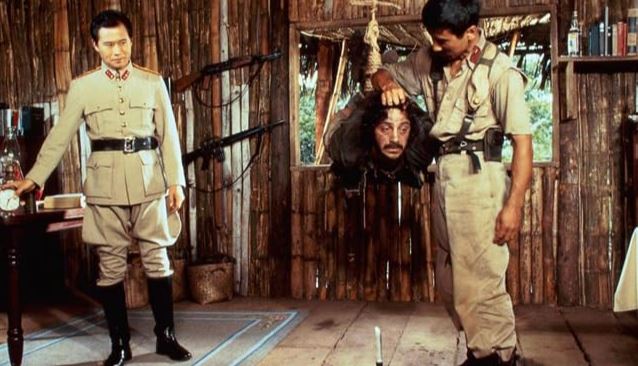
Once upon a time, Soon-Tek Oh (1932-2018) was America’s go-to Asian. Maybe the world’s. Whenever Hollywood needed a glaring visage from the Orient, Oh packed his bags, thanked his agent, and caught the first flight to glory. And while he was born in South Korea, he was versatile (and desperate) enough to play Chinese, Japanese, Cambodian, and yes, the occasional Filipino. Rumor has it he even portrayed a Norwegian in an off-Broadway production of A Doll’s House. It was a simple matter of survival. While others struggled to keep the rent paid, Oh was clogging the airwaves like a man possessed: five episodes of M*A*S*H*, two episodes of T.J. Hooker, four memorable turns in Magnum, P.I., as well as glorified cameos in Airwolf, Matt Houston, The Fall Guy, and Hill Street Blues. He even shared the screen with Gary Coleman in Diff’rent Strokes. You can suck on your pride in the unemployment line. The man simply loved to work.
So when it came time to play a sadistic Vietnamese Colonel in 1985’s Missing in Action 2: The Beginning, there was never a question of fighting back against caricature. Or stereotype. Or the very real prejudice that believes “any Asian will do.” Here was a lip-smacking part – alongside Chuck Norris, for chrissakes – and he was going to inhale every moment as if hooked to oxygen, clinging to life. Because Oh knew that while cinematic Asians rarely had depth, shading, or nuance, they did attract the necessary boos and catcalls to keep them well-fed. And if he could help America get over the stunning humiliation of its Southeast Asian adventure, well, so much the better. America paid his bills, and by God, he’ll be the first to carry the flag over the finish line.
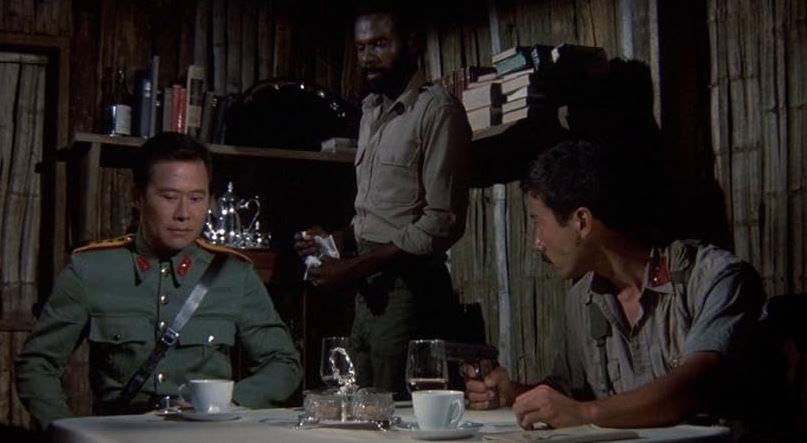
Just like Stallone’s turn in Rambo where he asked, “Do we get to win this time?”, Oh’s Colonel Yin provides an unambiguous retort: hell yes, with as many burnt, stabbed, and machine-gunned enemy soldiers as it takes to soothe Old Glory’s wounds. Because if Yin is anything, he is the ultimate reminder that what we were up against in Vietnam wasn’t your typical warfare. The bastards just didn’t play fair. While we came with the Geneva Convention’s rules and regulations tucked under our arms, they played to win with the requisite savagery, deception, and brutality of the region. Worst of all, they took hostages. Not for material gain or strategic advantage, mind you, but just because. To be mean. Spiteful. And yes, to push us to the brink. And so we have camps like Mr. Yin’s. While the setting is more akin to some backyard in Georgia, it can act as a Vietnamese stand-in because it must. The bold and the brave held captive to feed Yin’s constant battle against impotence.
Think of Yin’s methods. Goading poor Braddock with lies about his wife, burning precious letters from the home front, or attaching rats to necks in brutal acts of torture. He even stages his own Fight Club among the prisoners just for kicks. Yin’s dialogue is spare and clipped, but when he speaks, we know the score. “Take him to the tree,” he sniffs. “Throw him in the hole.” Evil distilled to as few words as possible because save for the inhuman, such men lack any semblance of an inner life. Every moment of every day is devoted to devising new ways of bringing pain to the angelic Yankees. He’s so vile, he doesn’t even know basic geography. In exchange for a humiliating confession about wholly invented war crimes, Yin offers to transport Braddock “across the border” into Thailand. Even though Vietnam does not share a border with Thailand. The director likely knew it, Oh certainly did, but when you’re pocketing five figures a week, you shut the hell up and play dumb.
And while we’re in the remote jungle, where showers and laundromats are in short supply, Yin is always impeccably dressed, changing uniforms every few hours just to rub his freshness in the faces of the filthy and sore-covered. He’s such a dandy, in fact, that he’s carried about – often at distances of several yards – in a makeshift rickshaw. He’s also so delicate that, despite having just set a man on fire, he insists on having an umbrella to accompany a slight drizzle. Braddock is not amused, setting the stage for the revenge to come. But until that glorious finale, we have Yin as the worst sort of soldier imaginable. Nothing he does is for king and country, or the glory of Communism, but rather to make a little bread with a side hustle. You see, he’s working with an obnoxious Frenchman producing and selling opium. The very Frenchman he will later betray and shoot down like a dog. You know you’re in the midst of evil when you can’t even trust a drug dealer.
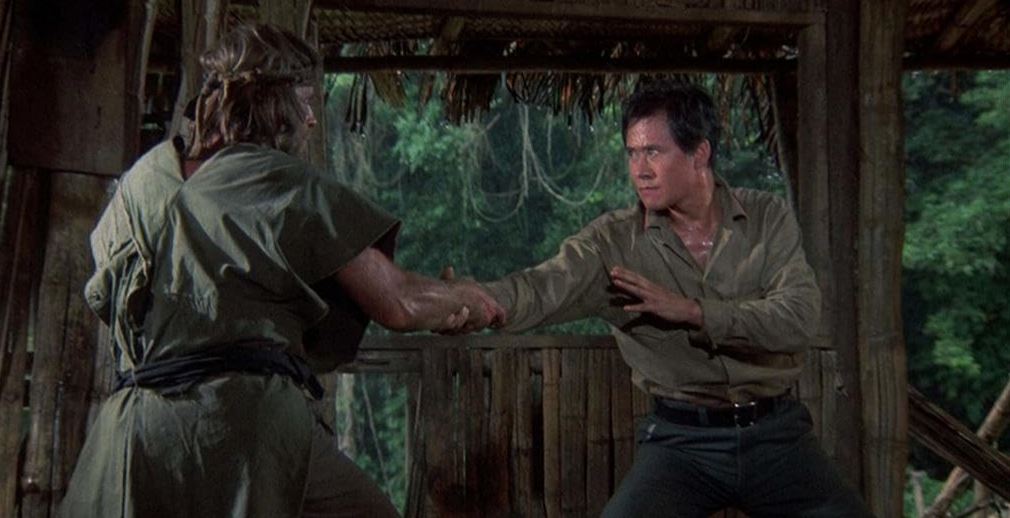
As expected, we endure Missing in Action 2 not for the unimaginative direction or absence of acting chops on display, but rather to see Yin and Braddock lock arms and battle to the death. Sure, if I’m a betting man, I’ll take the guy who does earth-downs rather than push-ups, but it’s not so easy dismissing a man like Yin. Yes, he has a stocked liquor cabinet, assorted effete oils and potions to stay young, and a stable of lackeys who do most of the work, but haven’t we borne witness to his karate skills? The sort of cunning where he knows to hide in the floor while all above succumbs to smoke and flame? And, above all else, the machismo to dispense with crude firearms in favor of fists and sheer grit? “No politics, no weapons,” he sneers. “Just a little game to find out who is the better man.” Fuck the Domino Theory, right there in full color is the solution to the entire Cold War.
And while we know that Yin is not going to best Chuck Norris in anything circa 1985, the height of the Golan-Globus propaganda machine, he more than puts up a fight. A courageous one, in fact. Following Braddock’s madhouse of a lead up, complete with walls of fire and more slo-motion back flips than a national tour of Cirque du Soleil, the two warriors settle in for skin-to-skin combat. Kicks and leg sweeps dominate the proceedings, right up to the moment that Braddock gives Yin at least a dozen punches to the face. No teeth are lost, consciousness is maintained, and Yin doesn’t even fall to the floor. Some blood, yes, just to prove he’s human, but never a cry to mama. Tough as nails, even in defeat. One could even argue he wins the moral argument on points. Instead of having the decency to murder his bete noire while looking him in the eye, Braddock turns on his heel, leaves the hut, and blows up Yin from afar. Like a coward. Not a physical trace of Yin is left behind, but his spirit soars. And you’d better believe his soul will be there as the United States cuts and runs at the Paris peace table.


Leave a Reply